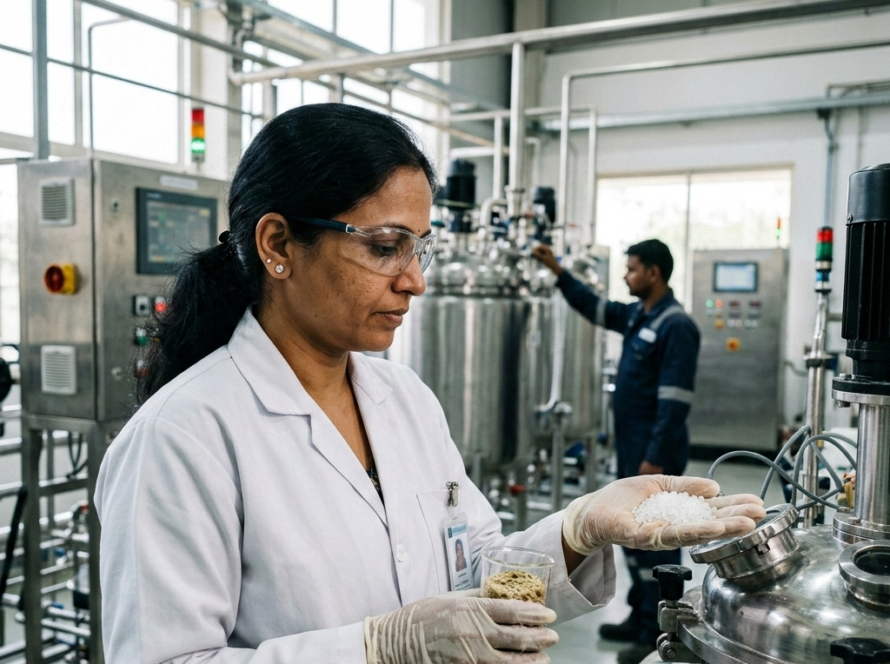
A rice farmer couldn’t get the yields he wanted. He had always done nitrogen on the same schedule and in the same amount every season. His neighbour was getting 20% more rice per acre and had the same soil, seeds and water.
What was the difference?
The difference was that the farmer’s soil was deficient in zinc. Without enough zinc, rice cannot process nitrogen as it should. As a result, rice cannot develop enzymes or chlorophyll, and protein synthesis is nearly non-existent for rice.
So, although this rice farmer was using nitrogen, he was using it incorrectly.
This example illustrates a larger issue that exists in all agriculture, a general tendency toward thinking of nutrients as being limited by the amount of NPK in an area. As the farmer in this example discovered, the limiting factor to productivity is not simply the nutrient(s) a crop is receiving at a low level; rather, it’s most often the nutrient(s) a crop has never received.
Liebig’s Law: The Chain Is Only as Strong as Its Weakest Mineral
For example, the principle of Liebig’s Law of the Minimum has existed since the 19th century — the plant that grows where maximum growth can take place is limited by the amount of the resource that can be grown during the time it takes to reach that maximum. According to Sound Agriculture, there’s no one nutrient that can replace another, if one of your macro or micro nutrients isn’t present in sufficient quantity, your crops will not be healthy or yield well, regardless of what you have from other sources.
This has tremendous implications for nutrient use efficiency (NUE); the NUE is the total amount of nutrients actually taken up and utilized by crops as compared to the total location of nutrients used by the crop itself. The missing limiting minerals will severely impact the crops’ ability to take up and utilize other nutrients from the soil. If you apply nitrogen without having sufficient zinc in the soil, you are essentially wasting your nitrogen.
The sheer magnitude of this problem is incredible. According to recent research published in Frontiers in Soil Science (2024), over 50 percent of India’s agricultural soils and 30 percent of China’s agricultural soils are deficient in available zinc, the mineral that is absolutely essential for proper enzyme activity; chlorophyll production; protein biosynthesis; and for high-efficiency photosynthesis. In India, the second most deficient nutrient is zinc; regardless of the fact that nitrogen will be the most limiting factor in lowland rice production, zinc is continuously under-represented in nutrition applications.
Why Minerals Don’t Work Alone: The Interaction Effect
The real benefit of multiple mineral nutrition is more than just correcting deficiencies associated with specific minerals; however, the greatest advantage of multiple mineral nutrition is found in the synergistic effects of the minerals when they are provided in balance with one another. For example, a study published in 2024 by MDPI Agronomy evaluated the co-application of zinc sulphate and sodium selenite to wheat at four different stages of growth. The foliar application of zinc alone increased the zinc content of the wheat grain by an average of 12-72%. However, when the two minerals were applied together, they produced an average of an additional 1.74-16.15% increase in the zinc content of the wheat grain over what was achieved with the application of zinc alone through their magnification of the bioavailability and/or transport of both minerals in the plants. The wheat grain produced from the combined treatment provided women with between 113-124% of the daily requirement of zinc and 95% of the Recommended Daily Intake of selenium for women, all produced from a single crop.
Manganese has a similar effect; it promotes seed germination, increases the rate of maturity of the crops, and improves the availability of phosphorus and calcium in the soil, according to the Micronutrient Fertilizers Market Report published by Precedence Research in 2025. If manganese is deficient, an application of phosphorus will not have the same level of effectiveness; therefore, manganese and phosphorus work together as a system and not independently of one another.
The relationship between phosphorus and zinc is just as critical and just as perilous if not heeded. As Sound Agriculture explains, overuse of phosphorus can lead to zinc deficiencies in crops because both ions compete for a spot on the surface of the roots. Farmers overusing phosphorus without checking zinc levels are risking a zinc deficiency that makes the phosphorus they are providing for nothing.
The Multi-Mineral Advantage: What the Numbers Show
The measurable and reliable yield and efficiency benefits from balanced multi-mineral nutrition are established through research using the total range of macronutrients and micronutrients, not only N, P, and K.
Through long-term strategies that combine mineral and organic forms of fertility, there is a 25-30% increase in available phosphorus, an 18-22% increase in available nitrogen, and a 15-20% increase in exchangeable potassium compared to chemical-only application (Frontiers in Microbiology, 2025). This increase is not simply due to supplying more nutrients; rather, the balanced mineral environments released the soil’s biological engine.
The same study indicated that an increase in microbial biomass of 2.5 to 3.8 times due to combined mineral and organic fertilization will activate soil enzyme activity (urease for nitrogen mineralization and phosphatase for phosphorus solubilization) to make nutrients biologically available.
In practical terms, combining multi-mineral nutrition and plant growth-promoting rhizobacteria can increase phosphorus uptake by up to 50%, while mycorrhizal fungi will allow roots to access mineral reserves that would not have been accessible.
As per a report from Precedence Research (2025), it was found that the market value of the micronutrient fertilizer market was above $5 billion in 2024. Moreover, it was also found that it will increase to above $9 billion in the next decade or till 2034. Further, it was also mentioned in this report that a CAGR of 6.72% will be achieved in this duration. The development of precise agricultural techniques and the realization of the significance of multiple mineral applications to obtain a high level of crop yield are the main factors that influenced the demand for zinc, boron, manganese, copper, and selenium as separate micronutrient fertilizer applications.
The Soil-to-Grain Chain: Minerals That Feed People, Not Just Plants
This story has more to it than just yield. The minerals found in soil that end up in the grain eventually provide human nutritional needs. According to a study published in Springer Science Reviews, zinc, selenium, and iodine concentrations in soil directly relate to how much zinc, selenium, and iodine a person eats through their diet. However, public health policy largely ignores this connection between soil and human nourishment. Because soil has little to no minerals, it does not only produce lower crop yields but also produces nutritious food that does not help these 2 billion people with “hidden hunger,” or lack of necessary minerals in their diets, globally.
When a farmer corrects zinc deficiency on his rice paddy, he is not just increasing nitrogen use efficiency: he is also creating more nutritious food. Thus, providing a multi-mineral diet can be thought of as both a tool for increasing productivity and as an intervention for food security.
Getting it Right: Precision Over Abundance
Multi-mineral nutrition does not indicate “apply more of everything.”
Instead, the message is to apply precisely what is needed versus applying more than what is needed. According to Sound Agriculture, regularly testing soil and tissue is needed in order to know exactly what minerals are limiting production. This way, producers can correct specific deficiencies versus just applying the same amount of product.
For example, with the farmer in the story who identified a gap in his zinc levels, the farmer did not need additional fertilizer; he simply needed to use the right kind. After he corrected his zinc levels, he began to get a return on his existing investment in nitrogen his yields improved, his input costs provided him with more grain, and soil health was improved/stabilised. This is what nutrient use efficiency means in practice.
It does not mean using less fertilizer, nor does it mean using more fertilizer; it means using complete fertilizer.