Fish populations in the open oceans are in decline. Conventional pond farming pollutes the waterway that it is reliant on. Global seafood consumption will rise 70% by 2050. Aquaculture needs a smarter production model ASAP. RAS aquaculture systems are increasingly becoming that solution, not because of how they are engineered, but rather because of the biology going through and around them. This is a science-based reference guide for how biological solutions in RAS are going to shape the future of sustainable fish farming.
What Are Recirculating Aquaculture Systems (RAS)?
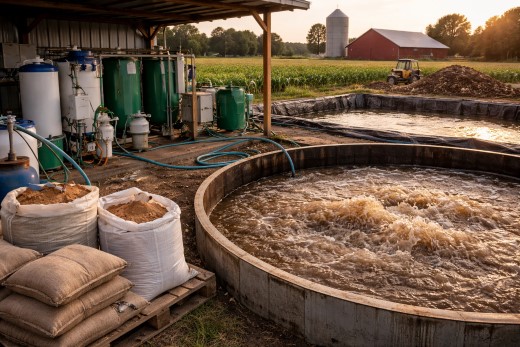
Land-based, closed-loop fish farming where water is treated and reused constantly, generally <1% of its original volume, or >99% recirculated. Open systems impose a high environmental cost due to direct loss of feed nitrogen and phosphorus into surrounding water bodies causing eutrophication and ecological damage. Most waste will be treated on-site in a closed-loop aquaculture system, resulting in a significant reduction of this discharge.
Key advantages of RAS fish farming:
- Biosecure production: the fish are never exposed to diseases and pathogens found in the wild nor have their production adversely affected by the weather.
- Independent of location: can be operated anywhere in the world, including landlocked areas.
- Environmental control is precise: operators have complete control over the levels of oxygen, pH, temperature, and density of fish in the tank.
- Water usage for RAS fish farming systems can be reduced by as much as 90%, according to the Biofloc Technology Review, 2025.
RAS Biofilter Technology: The Biological Engine
The biggest challenge of water quality management in RAS is nitrogen. The continual excretion of ammonia by fish at high concentrations is lethal to the fish. The solution to this problem is entirely biological. The use of biological filtration, or biofiltration, is used to colonise the filter media with nitrifying bacteria specifically Nitrosomonas and Nitrobacter which converts ammonium (NH3) to nitrite (NO2) to nitrate (NO3) through a continuous cycle, without the use of chemicals.
Current biological filtration in RAS includes:
- Moving Bed Biofilm Reactors (MBBR): are comprised of moving suspended polymeric (plastic) media in a compact system that optimizes the surface area for beneficial bacteria to develop on.
- Algal-Bacterial Bead Biofilters: where microalgae are encapsulated in alginate beads along with nitrifying bacteria to allow for simultaneous nitrification and oxygenation of water.
- Anaerobic Denitrification Bioreactors: which convert high levels of nitrate that accumulate in the final effluent to harmless nitrogen gas, as reported in the American Journal of Biosciences and Bioengineering (2025).
Biofloc Technology (BFT): When Waste Becomes Feed
Biofloc technology (BFT) is a relatively successful biological solution in recirculating aquaculture system (RAS) because it converts what is typically considered a major disadvantage (removing waste microbial populations) into a beneficial protein source (cultivating a dense concentration of bacteria, microalgae and organic materials in suspension) in the culture tank. Thus, BFT is capable of:
- Processing ammonia and nitrite, thus allowing for the maintenance of water quality without external treatment
- Creating protein-rich biomass (about 12-50% protein content) that can be consumed as feed by the fish/shrimp reared in the tanks (MDPI Fishes, 2025)
- Providing approximately 20-30% of the total protein requirements for tilapia and therefore dramatically reducing reliance on fish meal
- Reducing water treatment costs by at least 30% compared to conventional RAS (MDPI Fishes, 2025)
Shrimp farm operations using BFT have been able to achieve average yearly production levels ranging from 20-25 tonnes/ha (Biofloc Technology Review, 2025), which is substantially greater than what has previously been achieved through more traditional production techniques.
Microalgae Integration: Closing the RAS Loop Completely
Microalgae are the most exciting new frontier for Sustainable Recirculating Aquaculture Systems (RAS). Recent data supports this assertion.
Microalgae used in RAS photobioreactors can remove 60-90% of dissolved nutrients or are harvested as biomass that can be used as animal feed or for fertilizer (ScienceDirect, 2025). In a pilot study conducted in Spain, a high rate algal pond was able to treat effluent from a sole (fish) farm and remove 90% of the nitrogen and phosphorus it contained while also producing usable biomass for replacing up to 21.4% of fish meal ingredients (ScienceDirect, 2024).
Microalgae provide a complete biological loop inside RAS:
|
Function |
Benefit |
|
Absorb dissolved N & P |
Removes what biofilters miss |
|
Sequester fish-exhaled CO₂ |
Reduces aeration energy demand |
|
Generate oxygen |
Supplements dissolved oxygen supply |
|
Produce harvestable biomass |
Creates protein/carotenoid-rich co-feed |
As per MDPI Fishes (2026), microalgae act as a universal synergistic enhancer fixing the core weaknesses of both BFT and conventional RAS simultaneously.
AI and Smart Monitoring in RAS: Biology Meets Precision
The addition of artificial intelligence to RAS technology from 2020 to 2025 has made significant advancements and is an essential layer for RAS management systems now being driven by AI.
According to ScienceDirect (2025), these AI-driven management systems provide:
- Labor Cost Savings of 25% to 30%
- Feed Use Efficiency Improvements of 15% to 20%
- Real Time Alerting of Dissolved Oxygen, pH, and Temperature Anomalies
- 94% Biomass Estimate Accuracy with YOLOv8 Computer Vision in Tilapia RAS.
The integration of biological management with digital precision to establish next generation closed loop aquaculture is defined by the convergence of all of these elements.
Frequently Asked Questions About RAS Aquaculture
Q: What species are farmed using RAS?
At present, at least 46 fish species, 11 crustacean species, and 7 mollusk species are farmed using RAS.
Q: Is RAS sustainable?
Yes. This is especially true when integrating biological elements. This is because microalgae and biofloc integration in RAS promote near-zero waste production by converting waste nutrients into feed biomass.
Q: What is the biggest challenge in RAS farming?
The cost of capital and high energy costs is the biggest challenge in RAS farming. However, the integration of AI in optimisation, microalgae in co-production, and biofilters in design is helping to reduce the cost per kilogram of output.
Q: How does biofloc technology reduce costs in RAS?
Biofloc technology reduces fishmeal dependency, reduces water treatment costs by 30%, and also offers in-tank supplemental protein. All these help to reduce the 50- to 60-percent cost of feed and operation in intensive aquaculture.
The Bottom Line
Recirculating Aquaculture Systems (RAS) have moved past experimentation; they are now a viable seafood production model because of the combination of RAS’ integrated biofilter technology, biofloc technology, microalgae integration and artificial intelligence In addition, RAS is quickly becoming the most eco-friendly, efficient, and secure means of producing seafood.
The RAS aquaculture of the future is a closed biological loop in which fish, microflora and algae, and algorithms all contribute to one another without generating waste.