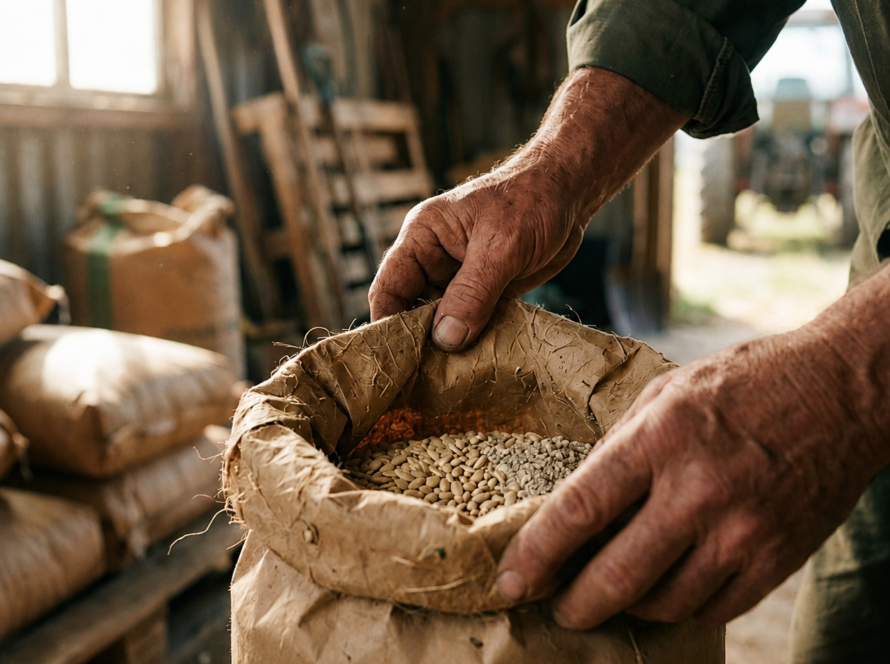
Reusing feed sacks feels like a much more practical choice. As they’re strong, already paid for, so throwing away a perfectly intact, reusable bag might seem wasteful. Across farms and feed stores, the same sack is reused for grains, fertilizer, pesticides and animal feed. But an important question is rather rarely asked that what was stored in the sack before, and could any residue still be left behind?
A Habit Nobody Questions
Reusing agrochemical packaging for food and feed storage is a documented, widespread practice and not a rare exception.
A peer-reviewed study on smallholder farming communities found that a significant majority of farmers (66% in the surveyed group) reused emptied pesticide containers and fertiliser bags for household purposes, including storing solid foods such as flour, lentils, and grains (Drivers of the Unintended Use of Emptied Chemical Containers by Smallholder Farmers, 2025).
Reporting from Indian farming villages echoes the same pattern. Pesticide packaging that instruction leaflets explicitly warn should be safely disposed of is instead cleaned and repurposed to store food and drink at home (Earth Island Journal, n.d.). Feed sacks, sitting in the same informal supply chain, follow the same logic i.e. reuse first and question later.
What’s Actually Sticking to the Fabric
Woven sacks are porous by design and that is what makes them breathable for grain and feed. It is also what makes them absorbent.
Research has identified aluminium phosphide, a fumigant used to protect stored grains from pests, as a possible contamination risk in storage sacks. The concern is that some suppliers place fumigant tablets directly inside the sacks instead of using the recommended method of treating the grain with the gas externally. This can leave residues on the sacks and create a potential food safety risk when they are reused for other products.
Once a chemical residue is worked into woven fibres, there is no reliable way for a farmer or feed handler to visually confirm it has fully cleared before the sack is filled again.
The Mycotoxin Multiplier
Chemical residue is only half the risk as reused sacks also carry organic residue like spilled grain dust, moisture, and old feed particles trapped in the weave which creates an ideal breeding ground for storage fungi.
It is important because mycotoxin contamination in livestock feed is now considered the norm rather than the exception. Recent surveys found that over 90% of tested livestock feed samples contained more than one mycotoxin simultaneously, including aflatoxins known to transfer into milk and meat (Fungal Contamination of Dairy Feed and Major Mycotoxin Transfer, 2026).
A sack that already carries fungal spores from its last contents gives any new batch of feed a head start toward contamination, well before it even reaches a barn.
Myth vs. Fact
“If a sack looks clean, it’s safe to reuse for feed.”
Not necessarily.
Pesticide and fumigant residues can be absorbed into woven fibres invisibly, and fungal spores from earlier contents can persist in the weave regardless of surface appearance. This is why a visual check cannot substitute for knowing a sack’s full history.
Washing It Isn’t a Real Fix
Rinsing a sack removes visible dust, not what has soaked into the material. Reviews of India’s grain storage practices note that several once-standard fumigants and pesticides including aluminium phosphide, chlorpyrifos, and malathion carry known toxicity or residue risks that outlast a simple wash, which is part of why global regulators have restricted or banned their continued use (Post-Harvest Grain Storage: Methods, Factors, and Eco-Friendly Solutions, 2025).
Even where India’s overall pesticide residue compliance is strong, national monitoring found 97.18% of over 209,000 food samples within prescribed limits over nine years (Global Agriculture, 2026) and that figure reflects tested commodities, not the informal, untracked life of a reused sack moving between unrelated products on a farm.
How TerraPHA Helps
This is where the packaging itself needs to change, not just the habits around it.
TerraPHA Biotech, World’s first commercial non-GMO biopolymer company, develop a PHA-based biopolymer packaging from renewable feedstocks, engineered by naturally occurring microbes to be fully biodegradable rather than durable-forever plastic.
Packaging designed this way removes the economic pressure that drives reuse in the first place and there is no need to stretch a sack’s life across pesticide, fertiliser, and feed if the material itself is affordable to replace and safely returns to the environment instead of persisting in a shed corner for years.
Frequently Asked Questions
Why do farmers reuse feed and fertiliser sacks so often?
Mainly cost and habit. Sacks are durable and already paid for, so discarding an intact one feels wasteful. Research on smallholder farming communities found the majority of farmers repurpose emptied agrochemical packaging for food and feed storage rather than disposing of it.
Can washing a reused sack remove pesticide or fumigant residue?
Not reliably. Chemicals such as aluminium phosphide can be absorbed into the woven fibres of a sack, not just sit on the surface, and Indian research has specifically flagged this as a contamination risk on grain storage sacks.
What health risk do mycotoxins in reused sacks actually pose?
Mycotoxins like aflatoxins can transfer from contaminated feed into animal products such as milk and meat. Recent research found that more than 90% of tested livestock feed samples contained multiple mycotoxins at once, underscoring how easily contamination compounds across a feed supply chain.
References
Contamination risk of aluminium phosphide residues on the packed wheat grain sacs. (n.d.). Journal of Entomological Research. https://indianjournals.com/article/jer-47-2-039
Drivers of the unintended use of emptied chemical containers by smallholder farmers. (2025, August 27). BMC Public Health. https://link.springer.com/article/10.1186/s12889-025-23848-0
Earth Island Journal. (n.d.). Pesticides are killing India’s farmers. https://www.earthisland.org/journal/index.php/articles/entry/agricultural-chemicals-are-killing-indian-farmers/
Fungal contamination of dairy feed and major mycotoxin transfer: A risk evaluation for animal exposure and health. (2026, January 13). MDPI Toxins. https://www.mdpi.com/2072-6651/18/1/42
Global Agriculture. (2026, June 17). Pesticide residues in Indian food: What 9 years of data tells us. https://www.global-agriculture.com/india-region/pesticide-residues-in-indian-food-what-9-years-of-data-tells-us/
Post-harvest grain storage: Methods, factors, and eco-friendly solutions. (2025, February 17). ScienceDirect. https://www.sciencedirect.com/science/article/abs/pii/S0956713525001057