Introduction
Can you guess how the future of farming would look like?
No, It won’t be all robots and stuff (well, not entirely).
Biopolymers, the naturally derived or microbe-made polymers are stepping up into the farming world with the confidence as they’re about to change everything starting from how seeds sprout to how soils thrive.
So what is that which makes biopolymers a game-changer the agriculture desperately needs?
What Exactly Are Biopolymers?
First of all, these aren’t your typical plastics. We’re talking about natural polymers like chitosan, alginate, cellulose, starch, and PHA that are derived from renewable sources, completely biodegradable, and possess some seriously impressive agricultural superpowers.
Think of them as the Avengers of sustainable farming, except instead of fighting aliens, they’re fighting drought, nutrient loss, and soil degradation.
Well, buckle up because this is exactly where the science meets our soil.
Biopolymers are literally revolutionizing how we feed, water, and protect our crops, and they’re doing it without leaving any kind of toxic residues or microplastic in our farmlands.
Biopolymer-Coated Fertilizers: A Smarter Way to Feed Crops
Let’s just talk about fertilizers for a second.
Traditional fertilizers dump all of their nutrients in the soil at once, plants can only absorb about 30% of it, and the rest? They’re just gone. Leached into groundwater, volatilized into thin air, or washed away by the rain.
Now let’s get to the biopolymer-coated fertilizers.
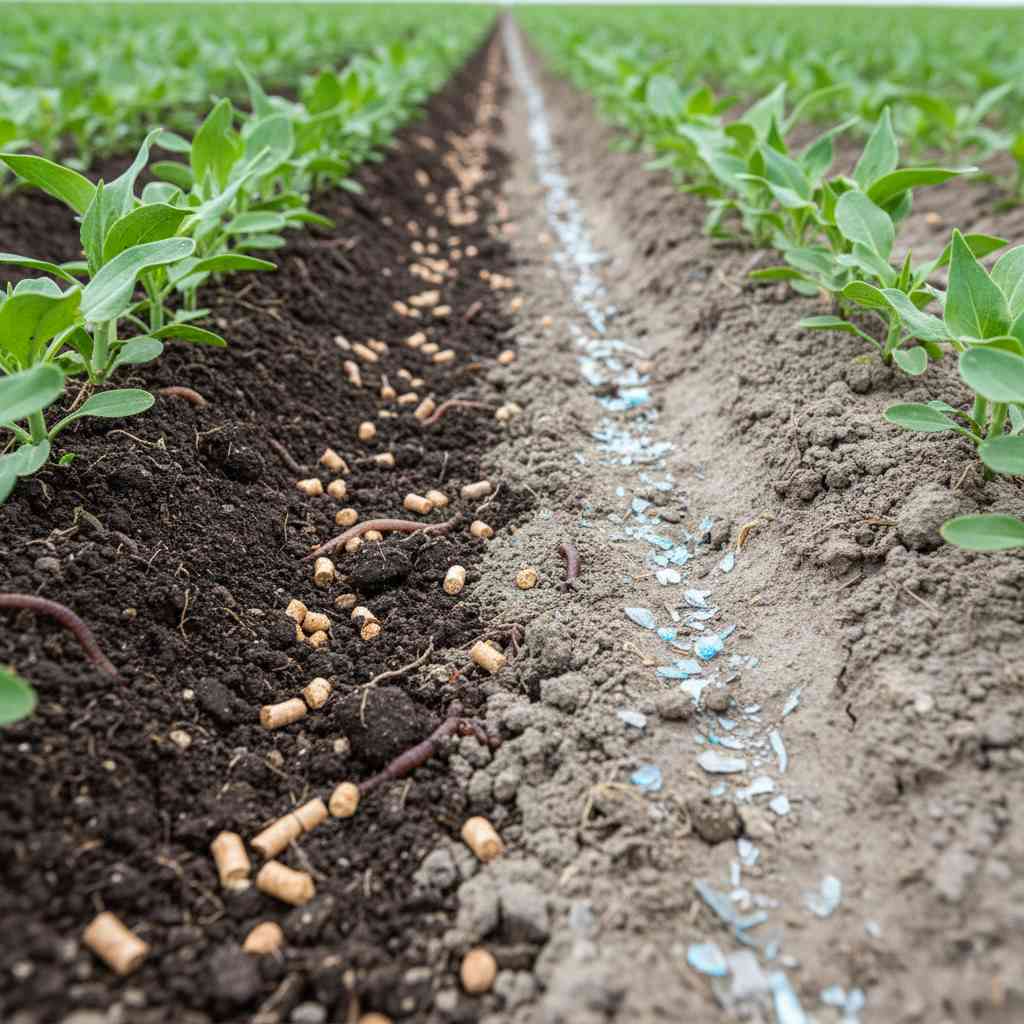
Chitosan, alginate, and starch are being used to create the controlled-release fertilizers that wrap all the nutrients in a biodegradable coating and release them slowly into the soil. Studies show these can reduce fertilizer usage by up to 40% while improving crop yields by 20-30%.
It’s like meal-prepping for your plants, except the meal prep actually biodegrades into harmless stuff like carbon dioxide, water, and biomass.
Replacing Plastic Mulch Films with Biodegradable Alternatives
Can’t miss to address the elephant in the field i.e. plastic mulch films.
For decades our farmers have been laying down polyethylene (PE) plastic films to suppress weeds, retain soil moisture, regulate temperature, and boost the yields. And well, it works too. But there’s a catch — after harvest all of that plastic needs to be removed, and most of it isn’t actually removed. It gets fragmented into microplastics which further contaminate the soil, disrupt microbial ecosystems, and persist for centuries.
But our biopolymers are changing this game with biodegradable mulch films made from materials like PBAT (polybutylene adipate terephthalate), PLA (polylactic acid), starch, and cellulose. These films could do everything that conventional plastic films would do like control weeds, conserve water, protect crops, but here’s the kicker — they biodegrade naturally into CO₂, water, and biomass.
No removal. No disposal. No microplastic pollution.
Research confirms that the soil microbes like bacteria and fungi could actually recognize these biopolymer films as food and metabolize them completely. A study from ETH Zürich showed that microorganisms use carbon from PBAT both for energy and biomass formation, meaning it genuinely biodegrades rather than lingering as microplastic residues.
Biopolymer Hydrogels: A Solution to Water Scarcity
Here’s another crisis agriculture is facing and that is water scarcity.
Hydrogels are 3D polymer networks that can absorb and retain large amounts of water — sometimes up to 500 times their own weight. When they’re mixed into soil, they act as tiny water reservoirs, soaking up water during irrigation or rainfall and gradually releasing it to plant roots during dry periods.
And yes, biopolymer-based hydrogels made from chitosan, alginate, cellulose, starch, and lignin are biodegradable alternatives to synthetic hydrogels that often contain harmful acrylamide residues.
The Bigger Picture: Farming With Nature, Not Against It
So overall biopolymers reduce the chemical inputs, conserve water, eliminate the plastic waste, improve soil health, and enhance crop productivity — all of this while respecting environmental limits and working with natural systems rather than against them.
They’re proof that we can feed a growing population without destroying the planet in the process.