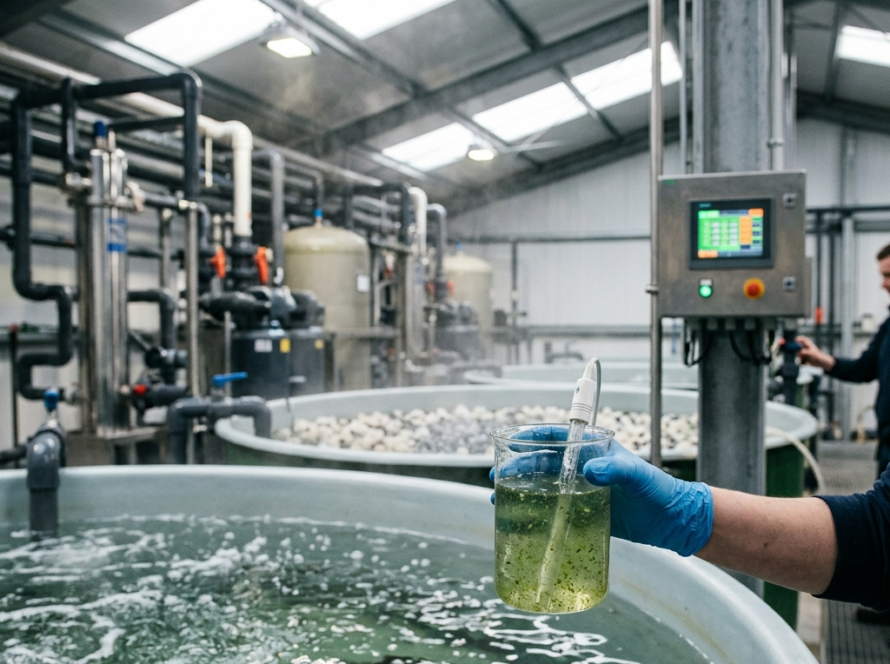
Few people imagine that the reason why fishes die in intensive pond systems is mostly from nitrate poisoning. It is true that disease outbreaks and oxygen crashes can be blamed partly, but the major killer acts silently.
It’s the nitrate buildup that is let loose by the heavy feeding practices which push a highly productive system beyond its safe limits that really kill the fish. A substantial amount of nitrogen can be produced in high, density and recirculating aquaculture setups wherein its value increases alarmingly sometimes to the level of hundreds of milligrams per liter thus, fish survival decreases drastically.
When nitrate surpasses a critical level, fish mortality goes up and overall performance plummets regardless of how advanced the infrastructure or genetics might be. Denitrification is the answer coming from something simple and natural that is also the biological pathway.
This process is done by microbes that change nitrates thus accumulated into nitrogen gas which is biologically neutral and it safely escapes from the system. Maybe it sounds quite mysterious, but it is very much backed by science.
Denitrification is the key stabilizing factor of highly loaded pond systems. A large assortment of beneficial bacterias like Pseudomonas, Halomonas, Dechloromonas, Rhodobacter, Flavobacterium, and Zoogloea are responsible for this process, whereby they convert nitrate into nitrogen gas step by step under low, oxygen or anaerobic conditions.
Moreover, in zero water exchange ponds, it was found that sediment, based denitrification accounted for most nitrogen removal at very measurable rates and that anammox pathway was less important nitrogen loss mechanism.
When it comes to recirculating aquaculture systems the difference can be spotted more distinctly. Denitrification bioreactors have shown excellent performance regarding nitrate removal while nitrite and ammonia remained at hardly measurable levels. The implications of this on the living organisms are straight forward fish survival at a very high rate and steady growth which means nitrogen control is not only linked to changes in water chemistry but to system productivity as well.
The underlying biology makes good use of itself. Denitrifying bacteria prefer to live where a source of carbon exists and where there is limited oxygen supply, such places are typical of biological filters, pond sediments, and suspended organic particles. By elevating the carbon-to-nitrogen ratio, one can further boost the performance of these bacteria thus, the key functional genes responsible for nitrate reduction become more abundant and total inorganic nitrogen is reduced to negligible and stable levels even during continuous feeding.
In reality, this means that denitrification should be considered the primary support system of eco, friendly, high intensive aquaculture operations.
The link between the two is direct. Denitrification should not be viewed only as a tool for improving water quality, but also as a way of making money. Aquaculture systems based on efficient denitrification mechanisms use only 110% of water that is normally needed by conventional operations. Reduced water exchange leads to greater stocking stability, less energy consumption, near zero environmental release, and safer, more stable product quality. Denitrification in zero, water, exchange systems, especially where biofloc technology is applied, continuously transforms toxic nitrogen compounds into harmless nitrogen gas, thus production can grow without increasing water inputs.
There is performance data that support these claims. On-site studies of aquaponic systems that integrate biofloc management with active denitrification reveal excellent growth results, effective feed usage, and high fish yields these are the signs of a commercially viable operation. Keeping the carbon-to-nitrogen ratio around 2. 3 has been reported as a good way to support denitrification at the highest level and keep all the major water, quality parameters within the safe limits.
The system structure itself plays an even more crucial role in nitrogen control. The suspended particulate matter in the pond water serves as a mobile habitat for the denitrifying microbes, where bigger particles harbor higher amounts of the essential functional genes involved in nitrate reduction. So, the biological loop doubles as a return system that constantly gets rid of the excess nitrogen, thus the system is stabilized, and the productivity is safeguarded for the long run.
Denitrification doesn’t just happen on its own.
According to a study, in unmanaged settlement ponds, only a tiny portion of the input nitrogen is removed through microbial pathways, with most of the system’s natural treatment potential remaining unused.
Such a break occurs mainly due to the lack of carbon availability, poor control of oxygen conditions, or the buildup of hydrogen sulfide that blocks the final step of the process.
At that point, nitrate reduction halts and switches to nitrous oxide production, a greenhouse gas that is much more harmful than carbon dioxide without finishing the conversion to harmless nitrogen gas.
The difference is very visible in the well, managed systems.
Ponds engineered with planned carbon supplementation, suitable biofilter structures, and regulated oxygen gradients always exhibit significant nitrate reductions through culture tanks. These results are the evidence of established and stable microbial communities that are capable of completing nitrogen’s full transformation pathway.
On the ground, efficient denitrification is not something that happens to the system naturally rather, it is a result of deliberate system design and management.
Why denitrification determines success? It is because in intensive aquaculture, the productivity of an operation is essentially dependent on nitrogen control. Denitrification is the only pathway that can be scaled up to remove nitrogen permanently and it does not depend on large water exchanges. Such systems that are able to actively harness this process can keep water quality stable while also reducing their operating costs, thus allowing them to increase stocking densities and at the same time protect the health of the fish. So when nitrogen is managed biologically instead of being diluted, performance, profitability, and sustainability come together.