India is transforming itself into a more sustainable future and has achieved two huge milestones related to biopolymers in less than a year. On 24th October, 2024, the Minister of State for Science and Technology, Dr. Jitendra Singh, opened the first demonstration plant in Jejuri, Pune for local production of polylactic acid (PLA).
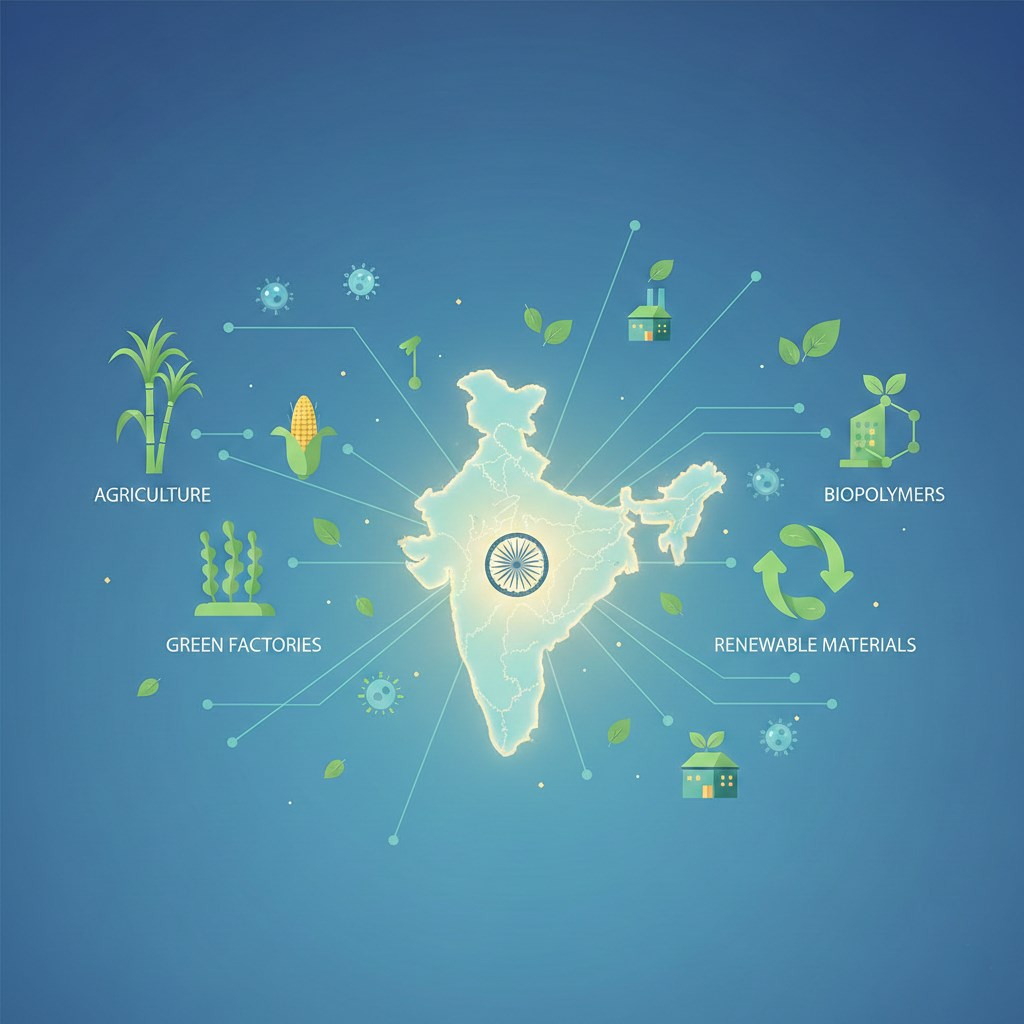
Then, in February 2025, Chief Minister Yogi Adityanath opened a new commercial-sized facility in Kumbhi, Uttar Pradesh. This facility, estimated to cost ₹2,880 crore, will be producing new biopolymers using renewable carbohydrates sources such as sugar, corn, and tapioca instead of conventional petrochemical-based plastics.
These new facilities are not simply research facilities; they are an indication of India starting to take steps towards becoming a major player in green manufacturing globally.
Important Points About the Transition:
Technological Autonomy: Changing from imported solutions to integrating PLA with domestic manufacturers.
Economic Scale: The Kumbhi plant will be one of the largest single investments in the bio-economy in India.
Circular Economy: Biodegradable materials will be produced from bi-products from agriculture (tapioca and sugarcane).
The BioE3 Policy Framework:
The Union Cabinet made several commitments to supporting technology through biotechnology (Biotechnology for Economy, Environment, and Jobs Policy – BioE3). With respect to this new policy, emerging trends indicate that convergence among biotech, engineering, and digitalization is occurring at a rapid rate.
Research by Nature on India’s biotechnology sector indicates that the country is experiencing rapid growth and biotechnology was measured at $10 billion in 2014 and projected to be at $165.7 billion in 2024, and $300 billion by 2030 (Frontiers in Bioengineering and Biotechnology).
Other reports from the Department of Biotech (PIB) indicate that India ranks 12th in biotechnology, hosts the 3rd largest startup ecosystem (over 10,000 biotech startups), and is currently the largest producer of vaccines globally. In addition, according to Nature, one of six focus areas related to the BioE3 policy is biopolymers and biobased chemicals.
The Infrastructure Buildout:
The Indian government launched 21 bio-manufacturing hubs along with the corresponding bio-foundry networks through “High-Performance Biomanufacturing Platforms” initiative in 2025, according to data collected by Shankar IAS Parliament.
There are currently 21 proposed projects funded through DBT for 6 from academia and 15 from the industry or those that are industry-academia collaborations. DBT also provides funding through various schemes to more than 30 institutions throughout India that are researching corn-based biopolymers, sustainable coatings and films, nano-cellulose, PGGA blends, bioplastics and waste conversion to bioplastics from seaweed.
Pharmatutor reports on DBT-BIRAC Call for Proposals to develop specific bioplastics based on the following precursors: 1,4-Butanediol, 2,3-Butanediol, butanol, succinic acid, lactic acid, polyhydroxybutyrate, and polyhydroxyalkanoates as well as bio-nylon: caprolactam, muconic acid and adipic acid.
The first National Biofoundry Network in India consists of six originally funded biofoundries that are implementing “high” performance biomanufacturing technologies including synthetic biology, artificial intelligence, machine learning, and other omics technologies, according to a study published by Frontiers based upon stakeholder consultations.
Why India’s Positioned for Leadership?
Because India combines massive agricultural feedstock availability, rapidly expanding manufacturing infrastructure, supportive government policies with Rs. 1,500 crore allocated for biomanufacturing missions according to IMPRI, and explosive startup ecosystems concentrated regionally. Research confirms the BioE3 policy aims to transform resource-intensive extractive manufacturing into regenerative, circular, bio-based production models, positioning India as a global leader in sustainable biomanufacturing.