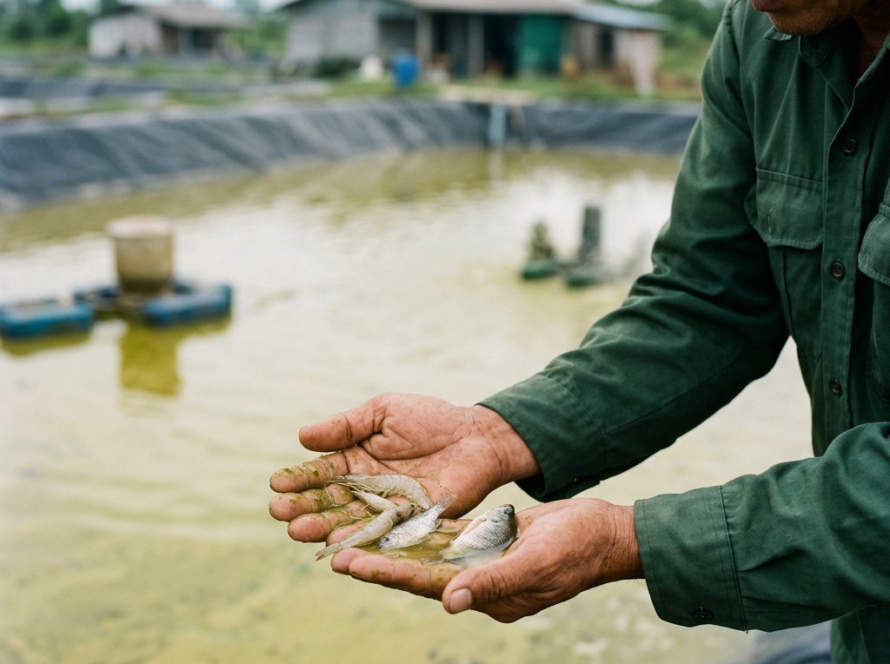
Every monsoon season, a wheat farmer in Haryana establishes his routine of broadcasting urea over the field after the seeds have been sown. This is quick, easy and has been done in the same way for generations. It has also worked for many years.
However, the farmer has no idea that about 50 percent of the nitrogen he applies never makes it to the wheat crop. Half of the nitrogen leaches into ground water; a different portion of the nitrogen converts to nitrous oxide (an extremely potent 273 times as strong as CO₂) and enters the atmosphere; and less than 50 percent of the nitrogen that is left in the soil will flood the plants’ roots at once and leave the crops to starve for nitrogen for several weeks when they enter the critical grain-filling period.
The farmer isn’t doing anything wrong, he’s farming the way agriculture was designed.
The issue is the design itself.
The Cost of Ineffective Fertilizers:
Today’s agricultural systems depend on nitrogen (N), phosphorus (P) and potassium (K). If these nutrients fail, worldwide crop production will come to an end. However, the efficiency of these nutrients being used is unbelievably low compared to other applicable products when compared to what is needed. In 2013, a detailed study conducted by the U.S. Environmental Protection Agency (USEPA) found that the best available collective research shows that only 20%-50% of N in traditional fertilizers reaches the crop, <25% of P in traditional fertilizers reaches the crop and <10% of pesticides in traditional pesticides reach the crop. The remainder is either washed away and carried into oceans, or penetrated groundwater, or dispersed into the atmosphere.
For farmers, though, environmental pollution produced due to this inefficient use of their crops is only one of the experiences of paying an unnecessary tax (an invisible tax) to grow their crops season after season.
Enter Smart Release: The Right Nutrient at the Right Moment
The principle behind CRFs (controlled-release fertilizers) and SRFs (slow-release fertilizers) is to deliver nutrients to plants at a rate that matches plant needs. Rather than releasing all of a fertilizer’s nitrogen at once, a fertilizer granule that has been coated or encapsulated will release its nutrients gradually, over a period of days, weeks, or even months, depending on the growth rate of the crop.
The technology behind both CRFs and SRFs varies and includes systems that utilize polymer coatings that will allow nutrients to be released at different rates based upon the temperature of the soil, pH responsive nanocarriers that will allow nutrients to be released only when they reach a certain pH, or osmotic pressure gradients where the coating expands as soil moisture is absorbed and releases an amount of nutrients equivalent to the amount of water the plant requires.
According to ScienceDirect (2024), CRFs not only reduces the amount of nutrients that are lost but can also create a nutrient release pattern that is unique for the physiological and biochemical processes of a plant. The end result of an increased level of nutrition to the plant, improves water quality, and lower input costs.
The Numbers Are Hard to Ignore:
A meta-analysis published in Frontiers in Plant Science (2025) synthesized the results of over 8,000 different studies conducted in different countries and concluded that by using controlled-release fertilizers instead of traditional fertilizers would increase crop yield, farmer profit, and nitrogen uptake by an average of 5.1%, 8.2%, and 7.1%, respectively, and decrease nitrogen loss from farming by 32.6%–49.1%.
The specific benefits to individual crops were even greater. According to MDPI Agriculture (2024), using controlled-release fertilizers increased tiller formation and grain production in winter wheat and helped produce yield increases from 3% to 15.3% as compared to using conventional fertilizers. Cotton yields increased from 12% to 22% when using controlled-release fertilizers, and in the case of rice, using one less application of controlled-release fertilizer at the initial planting time will lead to either a similar or greater yield due to superior tiller production than when using multiple applications of conventional urea.
Most significantly, a three-year field study (2022–2024) conducted in the Erhai Lake Basin in China (documented in ScienceDirect, 2025) determined that applying integrated granule fertilizers increased rice yields by 24.8% to 27.9% as compared to using conventional methods while reducing nitrogen leaching by 60% to 65% and total phosphorus runoff by nearly 50%.
The Nano Frontier: When Delivery Gets Precise
In addition to polymer coatings, the next evolution of smart release technologies is rapidly transitioning towards the development of nano-scale delivery systems. A prime example is chitosan nanoparticles containing herbicides which have been found to achieve 100% weed kill at standard doses and produce similar results with ten times less than the normal dosage of conventional applications in a Taylor and Francis published review (Pest Management Science) in 2025. This represents more than just an increase in a smart release method; it will result in a decrease in chemicals applied to the soil.
Bionanofertilizers are comprised of nanosized particles of beneficial microorganisms and provide additional performance advantages relative to traditional fertilizer sources. According to the article “How to Design a Microbial-Based Biofertilizer” published in Microbial Cell Factories in 2024, bionanofertilizer can enhance seed germination, improve soil quality, increase nutrient use efficiency, and degrade pesticide residues by acting as a single, targeted input. Bionanofertilizers only release nutrients at the root interface thus minimizing waste caused by fertilizer that is not used efficiently.
Additionally, lignin nanoparticles produced from agricultural residue offer a new type of biodegradable nanocarrier for pesticides and provide UV protection, antioxidant properties, and controlled degradation rates from crop residue according to the publication “Novel Nanocomposite-Based Formulations” found in ScienceDirect.
What This Means for the Future of Farming?
Controlled release devices were originally designed for a small research facility, but now have become an answer to a long-standing problem in agriculture, specifically in terms of the difference between what is applied by a farmer and what is absorbed by a plant.
The growing population in the world is projected to need a 60-70% increase in food production globally by 2050, while at the same time the world needs to decrease the impact of its chemical and carbon footprint from agriculture. Controlled release devices help solve both issues simultaneously by increasing productivity while also increasing sustainability.
The wheat farmer in Haryana may still broadcast his urea the way his father did. But science and increasingly economics are making a compelling case for change. Feed the crop, not the runoff. Release at the right time, not all at once.
That’s not just smarter agriculture. That’s what farming needs to look like going forward.