Ever wondered what the planet’s biggest carbon vault actually is?
It’s not the forests, nor the oceans.
It’s the ground we walk on every day.
Soils quietly hold more carbon than all living plants and the entire atmosphere combined which is around 2,400 gigatons locked within the upper two meters alone. That’s roughly triple the carbon floating above us. It’s an enormous reservoir, one that keeps the climate system in balance when left intact.
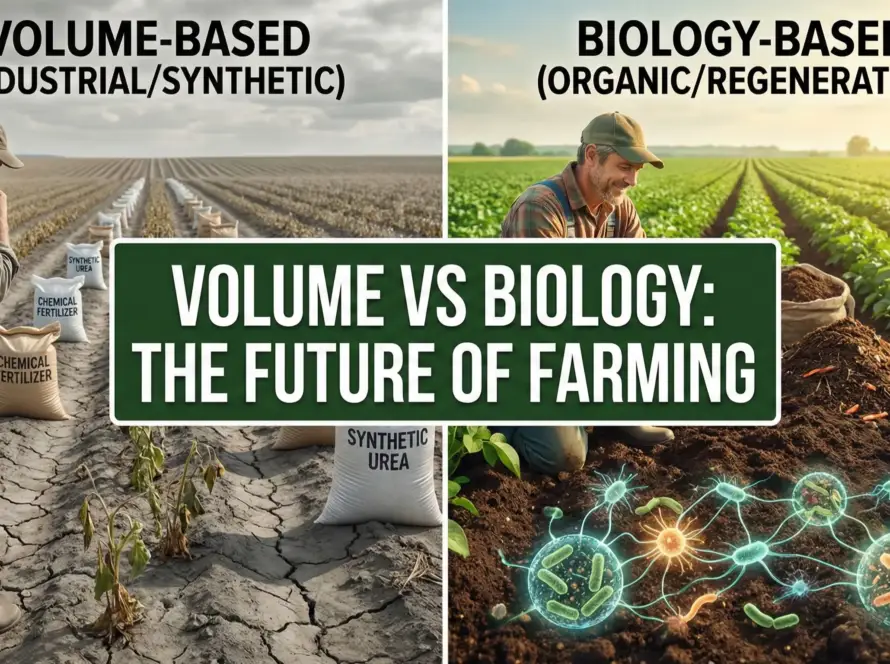
But here’s the painful truth, once land is plowed, cleared, or pushed into intensive farming, that carbon doesn’t stay put. Across North America, historic land conversion has stripped away 20 to 75 percent of the carbon once stored in topsoil, and in some regions the losses are accelerating faster than they can be accurately tracked.
Alarming? Yes. Absolutely.
This is the reality of soil carbon loss and it’s exactly where biotechnology may offer a path forward.
Why soil organic carbon actually matters?
It’s the backbone of fertile soil, and without it, food systems and entire ecosystems fall apart. Carbon-rich soils grow more resilient crops, hold water more effectively, and naturally filter contaminants, making them vital for any realistic vision of sustainable agriculture.
Studies have made it clear that boosting and protecting soil carbon accounts for roughly a quarter of all viable nature-based climate solutions. About 40 percent of that comes from simply safeguarding the carbon already stored underground; the remaining 60 percent depends on rebuilding what has been lost. In other words, conservation and restoration must happen side by side, but the reality is harsh. Once soil carbon is depleted, restoring it can take decades, and in some regions full recovery may never be achievable.
Ignoring the issue carries steep consequences. Yields decline. Waterways become polluted. Climate change accelerates as soil carbon leaks back into the atmosphere. Soil ecosystems break down to the point where they can no longer support farming. And meanwhile, global food demand is projected to climb nearly 60 percent by 2050. Trying to feed a growing population with soils that are steadily losing their life-supporting carbon isn’t just difficult, it’s impossible unless we change course now.
How biotech can restore it?
One of the most powerful combinations is biochar paired with targeted microbial communities. Biochar acts like a long-lasting framework in the soil i.e. porous, stable, and full of tiny cavities that function like housing blocks for microbes. It holds moisture, offers protection, and adds a form of carbon that can remain in the ground for hundreds of years. When you inoculate this structure with beneficial microbes, the results go far beyond incremental gains.
Research shows that soils treated with biochar plus microbial inoculants can experience remarkable jumps in biological activity. Microbial biomass carbon climbs sharply, enzymes like dehydrogenase increase, and nutrient-retention processes become far more efficient. In field trials, this combination raised soil organic matter by about 55 percent, boosted total nitrogen by around 33 percent, and elevated key enzyme activities by as much as 52 percent. These are the kinds of shifts that fundamentally change how soil behaves, how much carbon it holds, how plants grow, and how resilient fields become.
The underlying biology is beautifully efficient. Bio-organic fertilizers loaded with helpful microbes activate nitrogen fixers, phosphorus-solubilizing organisms, and other nutrient-cycling partners that release and stabilize carbon in the soil. Biochar, meanwhile, serves as the delivery system that keeps these organisms alive and active for months (sometimes up to a full year) while encouraging strong root colonization. The result is a self-reinforcing loop where microbes, plants, and soil structures all work together to rebuild carbon stocks without constant external inputs.
And this isn’t future theory. It’s a scalable path toward restoring the soil’s carbon bank using living systems that can maintain themselves once established.
Why this matters now?
Biotechnology is what turns that potential into something farmers can actually put into practice. Tools like biochar fortified with microbial consortia, seed coatings that encourage carbon-sequestering root systems, and enzyme-rich organic amendments give soils the biological machinery they need to rebuild structure, store carbon, and regenerate nutrient cycles.
The direction of travel is rather unmistakable. Either we regenerate soil organic carbon or we watch crop yields fall, ecosystems unravel, and climate pressures intensify. The science and technology already exist to reverse the decline. What’s left is committing to using them.