Conventional systems burn through staggering volumes of water, sometimes up to 80 cubic meters just to produce a single kilogram of shrimp. Farmers constantly drain and refill ponds to dilute waste, ammonia, uneaten feed, and pathogens. Every water exchange carries new risks. Disease can enter with incoming water, and polluted discharge harms surrounding ecosystems. It’s costly, inefficient, and environmentally damaging.
And yet, here comes the twist. Biotechnology has turned what once sounded impossible into a functioning, profitable reality.
Zero-water exchange farming isn’t theoretical anymore.
Welcome to biofloc technology, the approach that’s rewriting the rules of modern aquaculture.
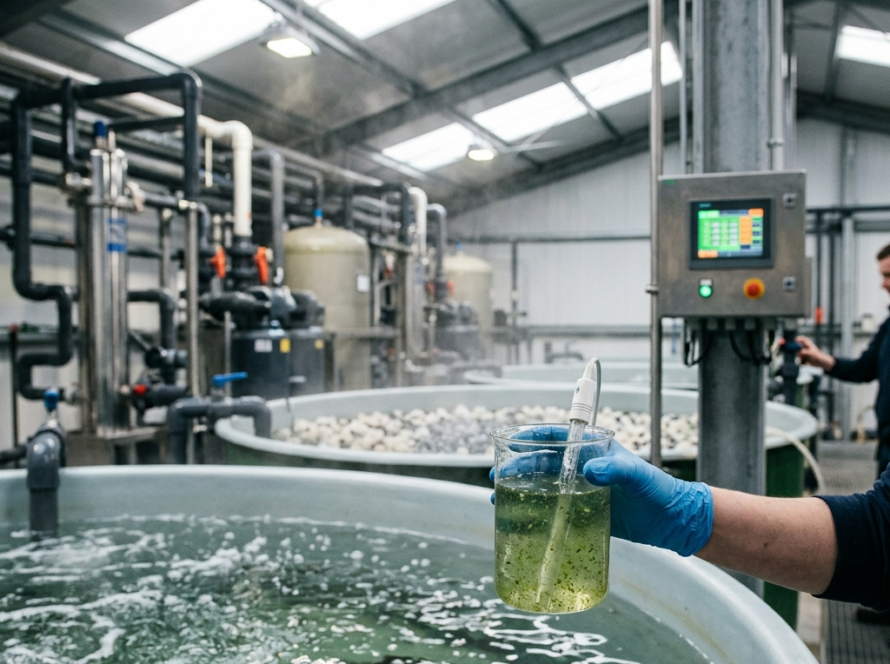
Here’s the real magic behind zero-water-exchange systems, instead of flushing out ammonia, nitrite, and organic waste, biofloc operations keep the same water in place and let microbial communities handle the cleanup. These systems run at high stocking densities but rely on continuous nutrient recycling rather than constant water replacement.
The entire setup hinges on adjusting the carbon-to-nitrogen balance. When farmers add a carbon source (molasses, rice bran, glucose) heterotrophic bacteria multiply rapidly. This surge of microbial activity pulls ammonia out of the water far faster than conventional nitrifying bacteria can, converting it into bacterial biomass that shrimp or fish can consume. Field data shows how dramatic the shift is, intensive shrimp culture using zero exchange can operate on 1 to about 2.26 cubic meters of water per kilogram of shrimp, compared with the 80 cubic meters required in traditional pond systems.
The flocs that develop are tiny living clusters of bacteria, microalgae, protozoa, fungi, and bits of organic matter stuck together. And they’re multitaskers. They clean the water by absorbing waste, they serve as a high-quality supplemental feed, and they help suppress pathogens by acting as natural probiotics. Research consistently shows that biofloc systems turn toxic nitrogen compounds into microbial protein that cultured species can digest.
In essence, you’re engineering a miniature, self-regulating ecosystem in the tank, one where the “waste” becomes a resource and microbes handle the work that once required endless water exchanges.
It’s time to be a little realistic, “zero-water exchange” in biofloc systems is never truly zero.
Most commercial operations still end up replacing about 0.5–1% of water per day to control salinity, manage sludge, or dilute excess solids. As the cycle progresses, nitrate inevitably builds up, and without intervention, partial water replacement or dedicated nitrate-management strategies the system can hit a biological ceiling.
Biofloc technology also isn’t a set-and-forget solution. It requires precise control of the carbon-to-nitrogen ratio, constant vigilance over dissolved oxygen, and regular measurement of floc volume. One misstep in the chemistry and the system can destabilize far more quickly than traditional pond culture.
On top of that, the aeration load is significant, driving up power consumption. The initial setup is technically demanding, and not every species thrives in dense microbial environments. Many farmers find the shift challenging not just because of the equipment, but because biofloc forces them to manage a living microbial ecosystem rather than simply manage fish or shrimp.
Why it actually works?
Because the science backs it and the performance data speaks for itself.
Biofloc systems, particularly in tilapia culture, consistently use around 40% less water than conventional recirculating aquaculture systems. Multiple studies also show that microbial protein generated within the floc can cut feed costs by up to 30%, while simultaneously improving feed conversion ratios and overall growth rates.
The near-zero water exchange model brings another critical advantage: high biosecurity. With no continuous inflow, there’s no external water pathway for pathogens, reducing disease pressure and stabilizing production cycles.
And this isn’t just theory. Commercial farms across Asia, Latin America, and now expanding into new regions are demonstrating that well-managed zero-exchange biofloc systems can scale reliably and profitably. The model works scientifically, operationally, and economically.
Is It Feasible?
The answer is a clear yes but with a critical condition. It’s not a simple switch.
Zero-water exchange aquaculture using biofloc technology is scientifically proven, commercially viable, and environmentally preferable to traditional systems. The challenge isn’t whether it works because the results are undeniable but the challenge is rather how it’s applied. Success demands careful monitoring, precise management of microbial communities, and a level of technical expertise that many farmers are still developing. The technology is ready, now the focus must shift to training, knowledge transfer, and practical implementation on the farm.