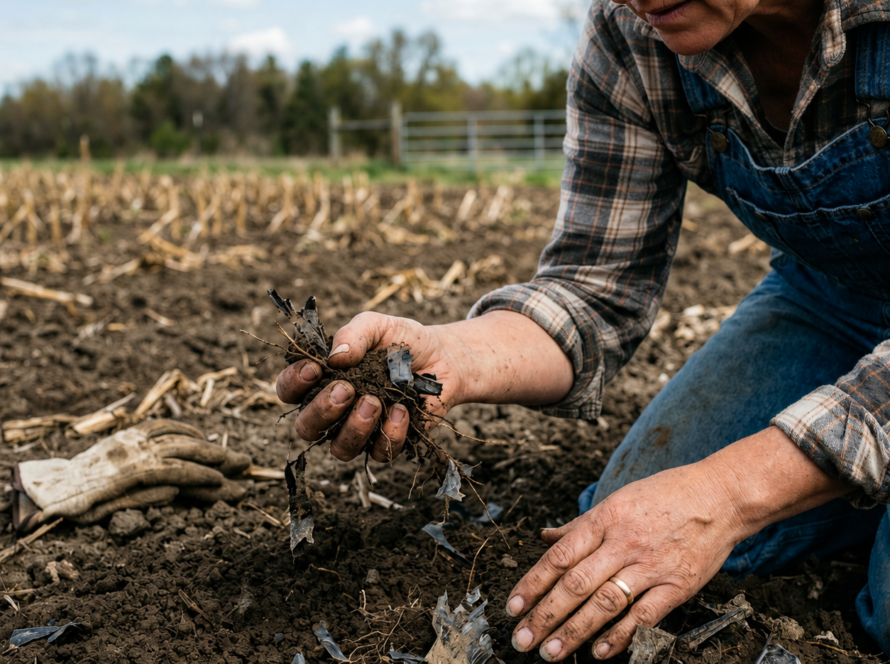
A brand switches to “compostable” packaging, prints a green leaf on the box, and feels good about it. Then a customer drops that box into a backyard compost bin, and even after six months the cup looks exactly like the day it went in. The gap between the claim and what actually happens is where sustainability credibility simply dies.
When the European Commission screened around 150 environmental claims, it found that 53% were vague, misleading, or unfounded. The UK’s Advertising Standards Authority has already pulled ads, including Lavazza coffee capsules marketed as “compostable” for the home when they were only certified for industrial composting (Packaging Europe, 2025).
“Bioplastic”
The word only tells you a material is bio-based, biodegradable, or both. Bio-based means made from plants instead of petroleum. Biodegradable means microbes can break it down. A material can be one without the other. Bio-based PET, made from sugarcane, never biodegrades. So “our packaging is a bioplastic” says almost nothing about what happens after someone throws it away.
Polylactic acid (PLA)
Polylactic acid (PLA) is the world’s best-selling compostable plastic, usually made from corn or sugarcane. The catch is the conditions. PLA needs the sustained 58-60°C heat of an industrial composting facility to break down. Narancic et al. (2018) tested neat PLA across seven environments and found it is not home compostable and showed no meaningful biodegradation in soil, freshwater, or marine settings. If a town has no industrial composter that accepts packaging, and most don’t, certified-compostable PLA behaves like ordinary plastic in a landfill.
Polyhydroxyalkanoates (PHA)
Polyhydroxyalkanoates (PHA) work differently because bacteria make them. The same microbes living in soil, compost, rivers, and seawater recognise PHA as food. Koller et al. (2025), who call PHA the “gold standard” among biodegradable materials, report that it meets marine biodegradation criteria (90% or more breakdown at 20-25°C in under six months) as well as home and industrial composting criteria. That matters because packaging escapes managed waste streams all the time. PHA is the rare material that still degrades when it ends up somewhere it was never meant to go.
| Checkpoints | PLA (Polylactic Acid) | PHA (Polyhydroxyalkanoates) |
| Made from | Corn or sugarcane starch | Bacterial fermentation of renewable carbon sources |
| Home compost | No | Yes |
| Soil | No meaningful biodegradation | Biodegrades through the action of soil microorganisms |
| Marine/Freshwater | Persists with little or no degradation | Biodegrades (≥90% degradation within 6 months at 20-25°C) |
| Industrial compost | Yes, under controlled conditions (58–60°C) | Yes |
| Best fit | Rigid packaging where industrial composting facilities are available | Packaging and products that are likely to escape into natural environments |
Table: How PLA and PHA behave across real disposal routes. Sources: Narancic et al. (2018); Koller et al. (2025).
Confusion is now a legal risk, not just a reputational one.
Vague green labels used to be a harmless marketing shortcut. Under EU Directive 2024/825, which applies from 27 September 2026, broad terms like “biodegradable,” “compostable,” and “eco-friendly” become high-risk unless the exact conditions and certification are stated on the same label (European Union, 2024). Saying “compostable” without saying where, home or industrial, is exactly the omission regulators are targeting. A brand that says “compostable” and means “industrial only” isn’t just risking a customer’s trust anymore. It’s risking a ruling.
Where TerraPHA fits
TerraPHA Biotech, World’s first commercial non-GMO biopolymer company, produces PHA from non-GMO microorganisms using renewable carbon sources. Because the material biodegrades across soil, freshwater, and marine environments rather than only inside an industrial composter, brands can make specific, defensible end-of-life claims instead of hopeful ones. Heading into stricter green-claims rules, that’s the difference between a label you can stand behind and one you’ll have to walk back.
Frequently Asked Questions
Is PLA biodegradable?
Technically yes, but only under industrial composting conditions of roughly 58-60°C. It doesn’t reliably break down in home compost, soil, or seawater.
Is PHA better than PLA?
For end-of-life, PHA degrades across far more environments, including marine and home compost. PLA is often cheaper and stiffer, which suits some rigid packaging. The right pick depends on where the product is likely to be thrown away.
Are all bioplastics compostable?
No. “Bioplastic” can mean bio-based, biodegradable, or both. Some bio-based plastics, like bio-PET, never biodegrade. Always check the specific certification, not the general label.
Can I put compostable packaging in my home compost?
Only if it’s certified home compostable. Industrial-only compostable items, including most PLA, won’t break down in a backyard bin.
References
European Commission. (n.d.). Green claims. European Commission. Retrieved from https://environment.ec.europa.eu/topics/circular-economy-topics/green-claims_en
European Union. (2024). Directive (EU) 2024/825 of the European Parliament and of the Council on empowering consumers for the green transition. Official Journal of the European Union.
Koller, M., Heeney, D., & Mukherjee, A. (2025). Biodegradability of polyhydroxyalkanoate (PHA) biopolyesters in nature: A review. Biodegradation, 36, 76. https://doi.org/10.1007/s10532-025-10164-y
Narancic, T., Verstichel, S., Reddy Chaganti, S., Morales-Gamez, L., Kenny, S. T., De Wilde, B., Babu Padamati, R., & O’Connor, K. E. (2018). Biodegradable plastic blends create new possibilities for end-of-life management of plastics but they are not a panacea for plastic pollution. Environmental Science & Technology, 52(18), 10441–10452. https://doi.org/10.1021/acs.est.8b02963
Packaging Europe. (2025, June 26). The brief: What EU law still says about misleading sustainability claims. Packaging Europe.