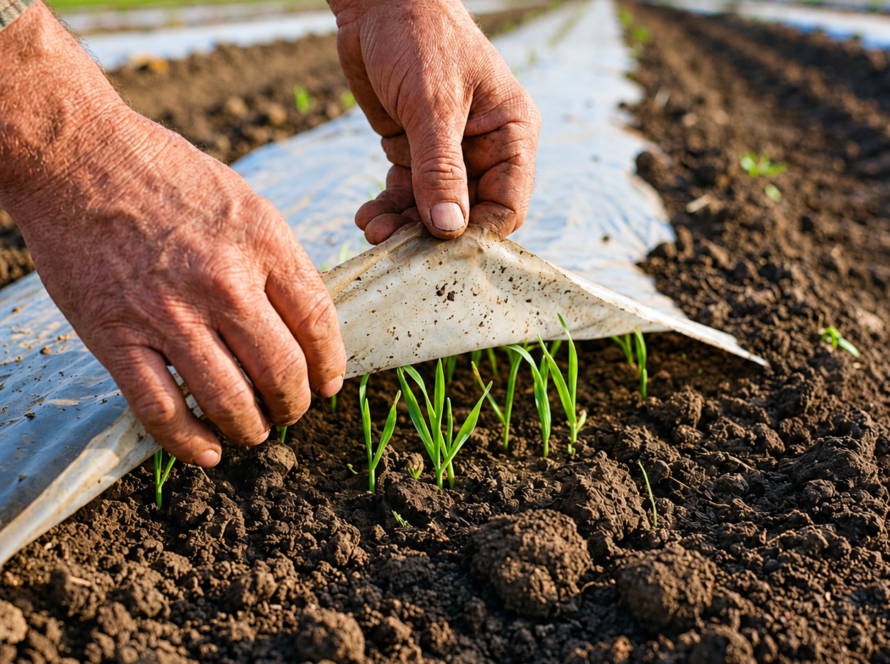
Polyethylene mulch does its job because it doesn’t break down, it holds moisture, warms the soil, and blocks weeds precisely because it resists the elements. That same durability is the problem at the end of the season. The film turns brittle under sun and handling, so when you lift it, it tears, and the fragments stay in the ground. Complete removal isn’t difficult, it’s effectively impossible.
The evidence on this is blunt. Researchers who sampled farms across California’s Central Coast. fields following “best practice” application and removal found plastic contamination in the surface soil of every single farm they tested (Tiwari & Sistla, 2024). Doing everything right does not get you to zero.
Residue doesn’t just sit there quietly, it compounds. In a field mulched for 32 straight years, film microplastics reached millions of particles per kilogram of soil, and the plastic films themselves accounted for 33-56% of all the microplastics found down the full soil profile (Li et al., 2022). Every season you add a little and nothing takes it away. The pile only grows.
This is not only an environmental footnote as it reaches the yield. Accumulated mulch residue is linked to reduced crop yield, plant height, and root mass, along with lower water infiltration, less soil carbon, and less plant-available phosphorus (Tiwari & Sistla, 2024). And the damage starts early. That California study found soil function declining at under 10% of the contamination levels previously assumed necessary to harm field soils (Tiwari & Sistla, 2024). The threshold for harm is a lot lower than the industry treated it as.
The Reality Behind “Just Switch to Biodegradable”
The obvious fix is a film that breaks down in the field, so there’s nothing to pull up. That is the right direction, but the label “biodegradable” is doing a lot of work. If a film only partially degrades, it can leave its own microplastics behind, and those residues can build up with repeated use just as the polyethylene did (Qi et al., 2021, as cited in Frontiers in Microbiology, 2025). The question is never simply “is it biodegradable?” but “does it fully mineralise in soil, at field temperatures, within a season?” Not every so-called biodegradable film clears that bar.
A mulch film earns the word “biodegradable” only if soil microbes can convert it fully to CO₂, water and biomass; not merely break it into smaller invisible pieces. Fragmenting is not degrading. Ask for the standard and the conditions, not just the claim.
How TerraPHA helps
TerraPHA Biotech, World’s first commercial non-GMO biopolymer company, produces polyhydroxyalkanoate (PHA) from naturally occurring, non-GMO microorganisms. PHA matters for mulch because it is one of the few materials that soil bacteria genuinely metabolise, the same microbes that ignore polyethylene recognise PHA as food and mineralise it in the ground.
A PHA-based mulch is designed to be tilled in and consumed rather than pulled up and hauled away, which removes the two failure points at once i.e. the fragments left behind by removal, and the persistent microplastics left behind by films that only half-degrade. It turns end-of-season plastic from a liability you manage into a step you can skip.
Frequently asked questions
If I remove my plastic mulch carefully, isn’t the soil fine?
Not entirely. A study of farms using best-practice removal still found plastic in the surface soil of every field sampled, because films tear during lifting and the fragments stay behind (Tiwari & Sistla, 2024). Careful removal reduces the problem; it does not eliminate it.
How long does plastic mulch residue stay in the soil?
Conventional polyethylene is designed not to degrade, so residues persist for many years and accumulate with each season. After 32 years of mulching, one field held millions of film microplastic particles per kilogram of soil (Li et al., 2022). What you leave behind this year is still there next year.
Does mulch residue actually lower my yield?
The research links accumulated residue to reduced crop yield, plant height and root mass, plus poorer water infiltration and lower available phosphorus and these effects showed up at low contamination levels (Tiwari & Sistla, 2024). It is a slow, compounding drag rather than a single dramatic loss.
Are biodegradable mulch films automatically safe for soil?
Not automatically. If a film only partly degrades, it can leave microplastics that accumulate over time (Qi et al., 2021, as cited in Frontiers in Microbiology, 2025). The test is whether it fully mineralises in soil under field conditions. Always ask for the standard, not just the word “biodegradable.”
References
Li, S., Ding, F., Flury, M., Wang, Z., Xu, L., Li, S., Jones, D. L., & Wang, J. (2022). Macro- and microplastic accumulation in soil after 32 years of plastic film mulching. Environmental Pollution, 300, 118945. https://doi.org/10.1016/j.envpol.2022.118945
Tiwari, E., & Sistla, S. (2024). Agricultural plastic pollution reduces soil function even under best management practices. PNAS Nexus, 3(10), pgae433. https://doi.org/10.1093/pnasnexus/pgae433
Frontiers in Microbiology. (2025). Impact of plastic mulch on soil microbial abundance, activity, and diversity in the saline-alkali soils of Xinjiang. Frontiers in Microbiology, 16, 1691334. https://doi.org/10.3389/fmicb.2025.1691334