Fish farms now feed more people than fishing boat fishermen do. In 2022, aquaculture produced 94.4 million tonnes of aquatic animals, 51% of the world total, and overtook wild capture for the first time in history (FAO, 2024).
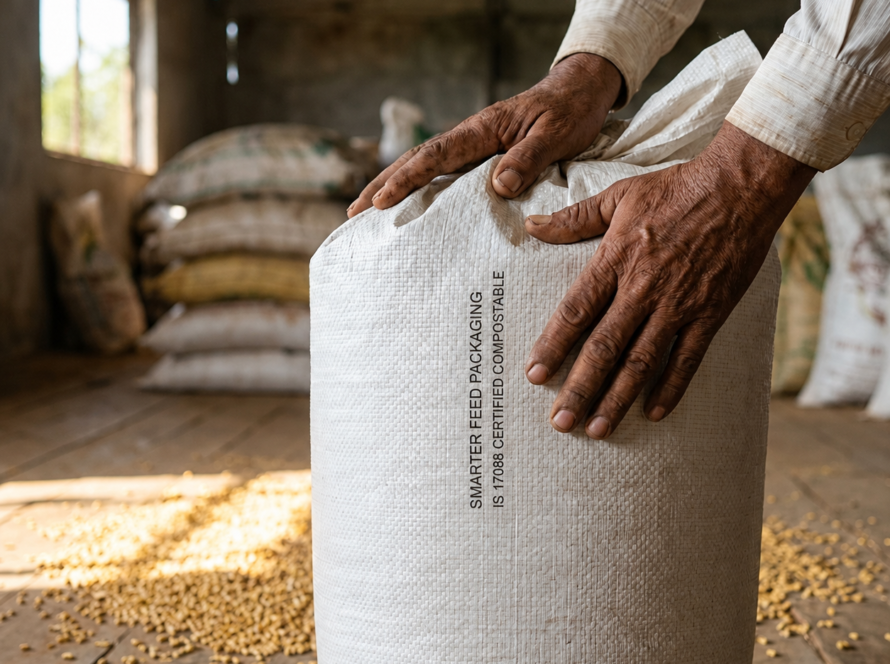
Every one of those tonnes travels through plastic on its way to a plate. Feed arrives in woven sacks, fingerlings arrives in lined bags, harvest leaves in crates, liners and film. Most of it is handled within a few metres of open water, which is what separates it from packaging in supermarket aisle.
Packaging Starts in Water and Ends Up in Water
Fisheries and aquaculture used roughly 2.1 million tonnes of plastic in 2019 (FAO, 2021). Set against 37.3 million tonnes for food packaging, that sounds modest. But location is what that matters as a feed sack that splits on a pontoon has no bin between it and the sea.
Skirtun et al. (2022). traced how plastic escapes marine farms in the North-East Atlantic due to rough weather, everyday farm habits, no recycling facility with reasonable distance, and cheap virgin plastic set against expensive recycling. Their study also found out that beach-litter surveys badly under-count aquaculture waste, because weathered fragments lose markings that would identify where they came from.
Around 25% of all fishing gear used worldwide is lost each year, amounting to 740,000 kilometers of longline, close to 14 billion hooks and more than 25 million pots and traps (Richardson et al., 2022). Aquaculture loses less, but same storms and waste handling gaps apply.
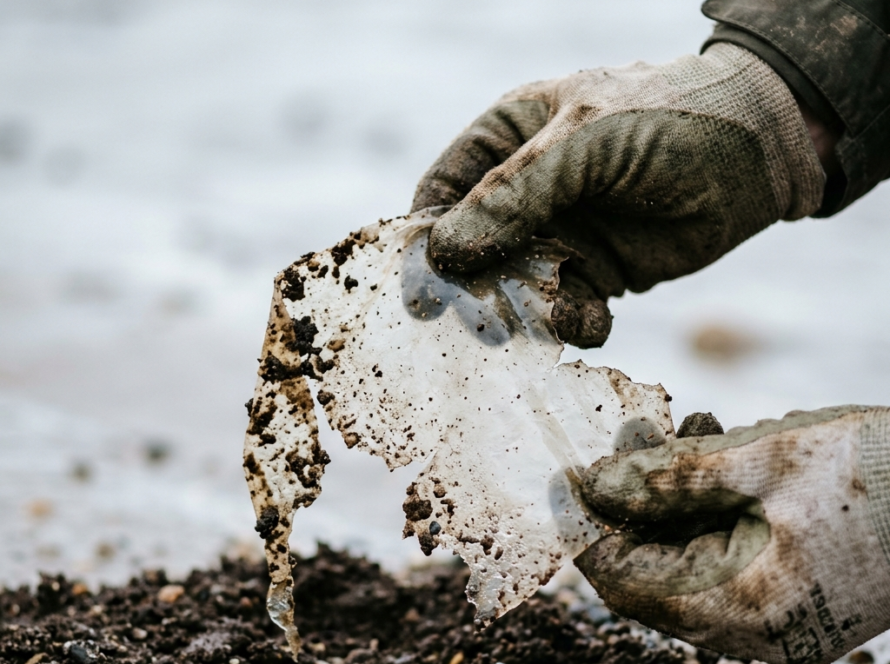
Once lost, conventional packaging does not go anywhere. Polypropylene sacks and polyethylene liners break into progressively smaller fragments that shellfish and filter-feeding fish take in. Globally, 19 to 23 million tonnes of plastic waste leaks into aquatic ecosystems every year (UNEP. n.d.).
PHA-Based Packaging
First and foremost, nothing can substitute for better handling, collection and recycling.
Polyhydroxyalkanoates, or PHAs, are polymers that bacteria build inside their own cells as an energy store. Because they are a natural bacterial product, marine microbes already carry the enzymes needed to break them down. Nothing in the ocean has an enzyme for polypropylene.
Dilkes-Hoffman et al. (2019) pooled the published marine data and put PHA’s biodegradation rate at 0.04 to 0.09 mg per day per square centimetre. A t that rate, a 35-micrometre film is gone in roughly 25 days to two months. A thick-walled item, such as an 800-micrometre bottle, takes 1.5 to 3.5 years. Conventional plastic in the same water is still there after centuries.
Thickness drives the timeline, and the points to where PHA fits in aquaculture today which includes sack liners, seed and fingerling pouches, hatchery films, sleeves and wraps. Load-bearing gear such as mooring rope and cage netting is a poorer fit, because strength needs bulk and bulk slows degradation.
One caution belongs in every purchasing decision. The word “biodegradable” only means something with a test behind it. TUV Austria’s OK biodegradable MARINE mark requires at least 90% biodegradation within six months under ASTM D6691 at 30 ± 2°C (TUV Austria, 2024). Real seawater is colder and less biologically active than a laboratory flask, so field lifetimes run longer than test figures. Ask a supplier which standard the material was tested against, and at what thickness.
How TerraPHA Fits
TerraPHA is the World’s first non-GMO biopolymer company producing PHA and PHA-based products using naturally occurring microbial system.
Packaging is a stated focus and aquaculture is one of the three sectors the company works across, alongside agriculture and animal husbandry, with bio-based inputs aimed at water quality and lower chemical use.
Frequently Asked Questions
Is biodegradable packaging just conventional packaging that breaks apart faster?
No. Oxo-degradable plastic fragments into microplastics without ever being consumed. PHA is metabolised by marine bacteria into carbon dioxide, water and biomass, which is why it can pass a marine biodegradation standard while fragmenting plastics cannot.
How long does PHA packaging take to disappear in seawater?
It depends on thickness entirely. Published marine data give roughly 25 days to two months for a 35-micrometre film, and 1.5 to 3.5 years for an 800-micrometre wall (Dilkes-Hoffman et al., 2019). Colder water slows this down.
Which aquaculture items suit PHA packaging today?
Thin, high-turnover, easily lost ones like feed sack liners, seed and fingerling pouches, hatchery films and wraps. Structural gear that needs high strength and thickness remains a harder problem.
References
Dilkes-Hoffman, L. S., Lant, P. A., Laycock, B., & Pratt, S. (2019). The rate of biodegradation of PHA bioplastics in the marine environment: A meta-study. Marine Pollution Bulletin, 142, 15–24. https://doi.org/10.1016/j.marpolbul.2019.03.020
Food and Agriculture Organization of the United Nations. (2021). Assessment of agricultural plastics and their sustainability: A call for action. FAO. https://openknowledge.fao.org/handle/20.500.14283/cb7856en
Food and Agriculture Organization of the United Nations. (2024). The state of world fisheries and aquaculture 2024: Blue transformation in action. FAO. https://doi.org/10.4060/cd0683en
Richardson, K., Hardesty, B. D., Vince, J., & Wilcox, C. (2022). Global estimates of fishing gear lost to the ocean each year. Science Advances, 8(41), Article eabq0135. https://doi.org/10.1126/sciadv.abq0135
Skirtun, M., Sandra, M., Strietman, W. J., van den Burg, S. W. K., De Raedemaecker, F., & Devriese, L. I. (2022). Plastic pollution pathways from marine aquaculture practices and potential solutions for the North-East Atlantic region. Marine Pollution Bulletin, 174, Article 113178. https://doi.org/10.1016/j.marpolbul.2021.113178
TÜV Austria. (2024). OK biodegradable MARINE: Initial acceptance tests (CS-OK12). TÜV Austria Belgium. https://be.tuvaustria.com/wp-content/uploads/sites/73/2024/03/CS-OK12-EN_biodegradable_MARINE.pdf
United Nations Environment Programme. (n.d.). Plastic pollution & marine litter. Retrieved September 4, 2026, from https://www.unep.org/topics/ocean-seas-and-coasts/ecosystem-degradation-pollution/plastic-pollution-marine-litter