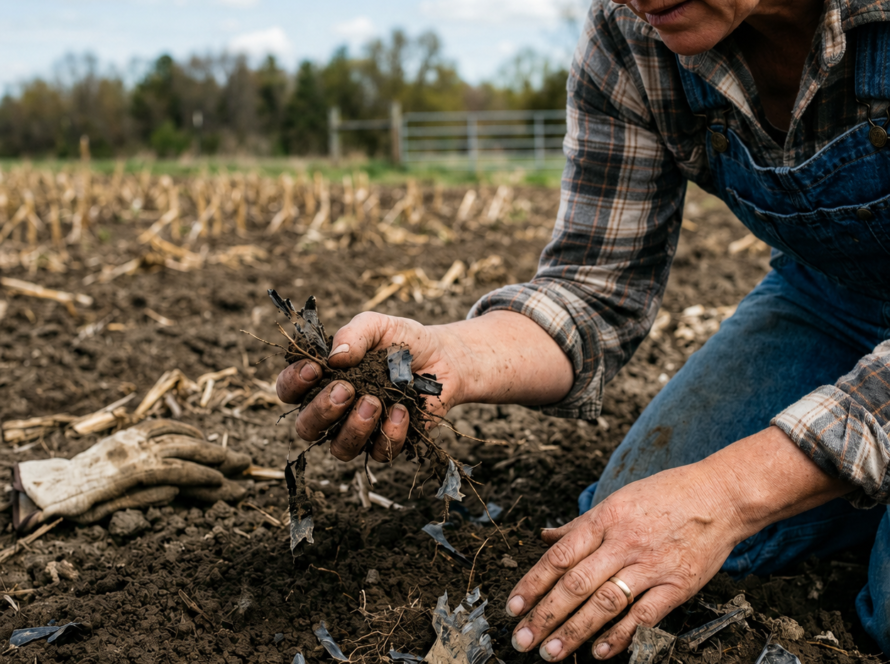
“Biodegradable” might be the least precise word on a packaging spec sheet. As a material can be called biodegradable but behave nothing like it. Because biodegradability doesn’t have a timeline.
Eventually everything will break down, but when?
That’s the question.
When it degrades, how fast, and who verified it.
Polyhydroxyalkanoates
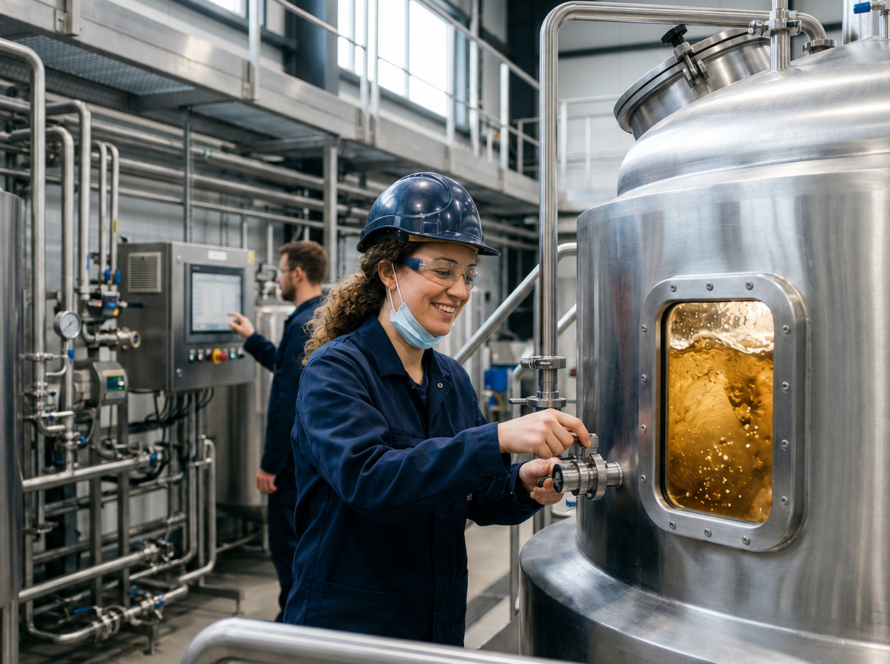
PHA is a polyester that bacteria build inside their own cells. When a microbe has plenty of carbon but runs short of nitrogen, it stores the surplus as granules, roughly the way an animal stores fat. Producers grow those bacteria in controlled fermentation on a renewable carbon source, then recover the polymer from the harvested biomass.
PHA is a family, not a single material. PHB (polyhydroxybutyrate) is best-known member. Copolymers such as PHBV and PHBHHx come from changing the feed or the strain, which shifts how stiff or stretchy the finished polymer is.
That origin is the crux of the comparison. Bacteria have been making and eating PHA for a very long time, so microbes across soil, freshwater, seawater, geothermal springs and even cryogenic soils secrete dedicated enzymes, called PHA depolymerases, that cut the polymer into fragments they can feed on. Synthetic biodegradable plastics have no such enzymes waiting for them.
Advantages of PHA
The practical advantage is that PHA degrades in ambient conditions rather than only in heated compost. Coastal seawater trials on PHBV film recorded 60-100% weight loss within 6 to 17 weeks (Suzuki et al., 2021). and isolated degrader strains work far faster in the lab, where one Pseudomonas isolate cleared PHB film in 21 hours (Paloyan et al., 2025). Breakdown returns the carbon to microbial biomass and CO2, leaving no persistent residue.
It also performs like a real plastic. PHB melts at 170-180°C against 175-180°C for polypropylene, and reaches tensile strength of about 38 MPa where PP sits between 15 and 40 MPa. Grades can be tuned. PHBV is tougher and more flexible than straight PHB, and PHBHHx behaves closer to polyethylene. The carbon comes from renewable feedstock rather than petroleum monomers.
PHA vs Other Bioplastics
PLA: Polylactic acid is bio-based, polymerised from lactic acid out of fermented sugar. Its limitation is that degradation depends on heat. PLA’s glass transition is 58°C amorphous and 62°C semi-crystalline. In industrial compost at 58 ± 2°C roughly 90% converts to CO2 within 70 days, but home composting needs around 24 months to reach the same point, and degradation in ambient soil or seawater is low (Lors et al., 2025). PLA is compostable but it needs infrastructure that most countries do not yet have at scale.
PBAT: This flexible copolyester appears in most compostable films sold today. It is fossil-based, synthesized from adipic acid, terephthalic acid and 1,4-butanediol, and it composts well under heat and moisture but stalls outside those conditions.
Strach-based blends: Thermoplastic starch degrades readily but is weak and water-sensitive alone, so it is compounded with PLA or PBAT. The blend inherits the end-of-life behaviour of its least degradable components, which is why a “starch-based” label says little without the full formulation and a test report.
| Material | Carbon source | Industrial compost | Home compost / soil | Marine |
| PHA | Renewable, microbial fermentation | Yes | Yes | Yes, rate depends on thickness and temperature |
| PLA | Renewable, fermented sugar | Yes, ~90% in 70 days at 58 °C | Slow; ~24 months in home compost | Minimal |
| PBAT | Fossil (petroleum monomers) | Yes | Very slow in soil (2.3% in 119 days) | Not established |
| Starch blends | Partly renewable | Depends on blend partner | Depends on blend partner | Depends on blend partner |
Limits and Reality
PHB is stiff and brittle, with elongation at break in the 1-15% range, and its processing window sits close to its degradation temperature (Turco et al., 2021). Copolymer grades solve much of that, at a cost.
Marine degradation is not instantaneous either. A 1mm PHBV film needed roughly 350 weeks in seawater, against 6-75 weeks in soil or freshwater (Suzuki et al., 2021). Thickness, crystallinity and water temperature move those numbers a lot. Any supplier quoting one degradation figure without naming the thickness, the test standard and the environment is quoting marketing, not data.
Where TerraPHA Fits
TerraPHA Biotech is the World’s first non-GMO biopolymer company producing PHA and PHA-based products for multiple sectors in the market. PHA is produced using naturally occurring non-GMO microbial systems and precision-controlled fermentation across a range of renewable carbon sources.
Since degradation performance varies with grade, thickness and end environment, buyers evaluating a specific format should request format-specific data or customized formulation.
Endnote
The bioplastics category has a credibility problem, and it comes from materials whose real behaviour depends on infrastructure that mostly does not exist. PHA is different for a structural reason. It was a microbial food source long before it was a packaging material, and the enzymes that break it down are already present in the environments where plastic actually ends up. That does not make it right for every application but it does make its end-of-life claim much easier to defend.
Frequently Asked Questions
Is PHA the same as PLA?
No. Both are bio-based polyesters, but PLA is polymerised from fermented lactic acid and needs composting near 58°C to break quickly, while PHA is made inside bacterial cells and is degraded by naturally occurring microbial enzymes in soil, freshwater and seawater without additional heat requirement as such.
Does PHA really biodegrade in the ocean?
Seawater trials on PHBV film report 60-100% weight loss in 6-7 weeks, while thicker samples take far longer, with a 1mm film requiring around 350 weeks (Suzuki et al., 2021). Rate depends on thickness, temperature and the local microbial population, so any claim should name a test standard and a sample geometry.
Is PBAT a biodegradable alternative to PHA?
PBAT is certified compostable and performs well in composting conditions, but it is made from petroleum-derived monomers and degrades very slowly in ambient soil, with one study reporting 2.3% mass loss over 119 days (Sousa et al., 2022, as cited in Wang & Guo, 2026).
Reference
Lors, C., Leleux, P., & Park, C. H. (2025). State of the art on biodegradability of bio-based plastics containing polylactic acid. Frontiers in Materials, 11, 1476484. https://doi.org/10.3389/fmats.2024.1476484
Paloyan, A., Tadevosyan, M., Ghevondyan, D., Khoyetsyan, L., Karapetyan, M., Margaryan, A., Antranikian, G., & Panosyan, H. (2025). Biodegradation of polyhydroxyalkanoates: Current state and future prospects. Frontiers in Microbiology, 16, 1542468. https://doi.org/10.3389/fmicb.2025.1542468
Suzuki, M., Tachibana, Y., & Kasuya, K. (2021). Biodegradability of poly(3-hydroxyalkanoate) and poly(εcaprolactone) via biological carbon cycles in marine environments. Polymer Journal, 53, 47–66. https://doi.org/10.1038/s41428-020-00396-5
Turco, R., et al. (2021). In vivo and post-synthesis strategies to enhance the properties of PHB-based materials: A review. Frontiers in Bioengineering and Biotechnology, 8, 619266. https://doi.org/10.3389/fbioe.2020.619266
Wang, X., & Guo, J. (2026). Recent advances in poly(butylene adipate-co-terephthalate) (PBAT): Structure, modification strategies, degradation, and sustainable applications. Frontiers in Chemistry, 14, 1862076.