Every year, the world produces a huge amount of animal feed, and most of it needs to be transported. Global feed production reached 1.44 billion tonnes in 2025, an increase of 2.9% from the previous year (Alltech, 2026).
A feed sack has a simple but an important job and that is to keep the feed dry, protect it from insects and rodents, and survive handling during transport and storage. But once the feed is used, the sack is usually thrown away. This creates a growing waste problem and is why the industry is now looking for more sustainable alternatives to conventional feed bags.
Current Use of Plastic in Livestock Feed Packaging
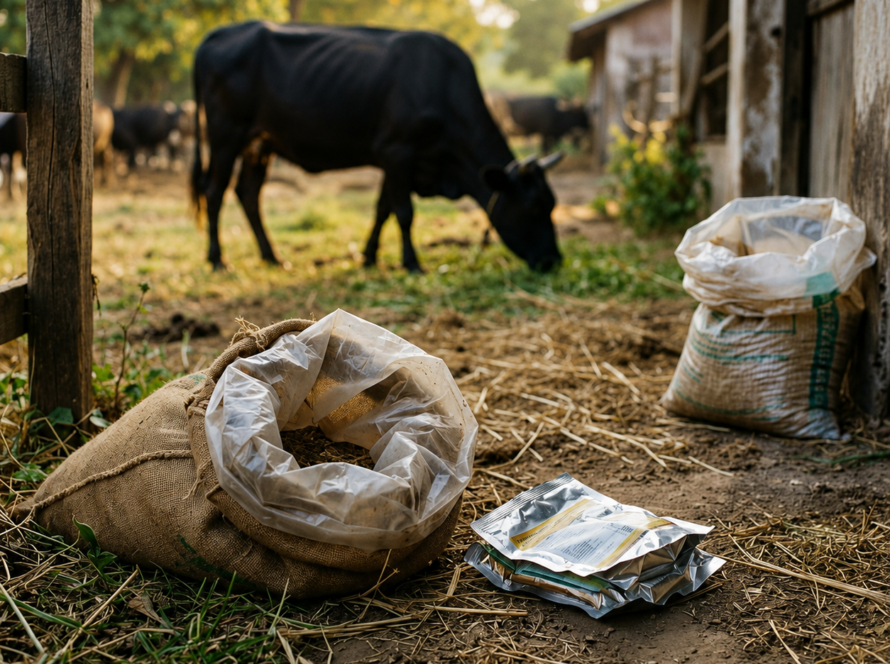
Most of the feedstock bag are made of polypropylene. It is cheap, it does not tear easily, and water runs off it. Many bags add a polyethylene liner or a printed outer film for branding and extra moisture protection.
Research on feed storage reflects how standard this has become. A Ghanaian study of poultry farms ran its entire comparison using 100-kg woven polypropylene bags as the baseline, because that is simply what farmers there use (Opoku et al., 2024).
On farms far which are far from any collection system, empty sacks are commonly burned, buried or left in a corner of a field. Conventional packaging plastics persist in the environment for a very long time and break into smaller fragments rather than disappearing.
Sustainable Alternatives to Conventional Plastic
There are three practical alternatives to traditional plastic feed bags:
Kraft paper sacks: These can be given a thin biodegradable coating to protect dry feed. They work best when the feed is stored for a short period.
Bio-based polymers: These replace conventional plastic while keeping the familiar bag design, making them easier to adopt.
Reusable bulk containers: These can greatly reduce packaging waste because the same container is used multiple times. However, they are more suitable for customers who buy feed in large quantities and can manage the return system.
In practice, feed mills may use different packaging options depending on the customer’s needs, order size, and storage time.
Bio-Based Packaging Material
These are polymers made from plants or microbes instead of petroleum. For example, Polylactic acid comes from fermented plant sugars. Polyhydroxyalkanoates, or PHA, are made inside bacterial cells and stored the way we store fat. Starch blends are the lower-cost options.
Among these, PHA is particularly promising for animal feed packaging. It can be processed much like conventional plastic, is compostable, and is considered non-toxic. Researchers see it as a possible link between traditional petroleum-based plastics and more sustainable packaging materials.
Rice husks, corn cobs and fruit peels can all be converted into packaging material, and PHA itself can be produced by fermenting agricultural waste. A feed mill already handles these residues. Bran, husk and screenings pass through the plant every day. A mill that turns part of the stream into its own packaging closes a loop that almost no other industry is positioned to close.
Functional Requirements of Sustainable Feed Packaging
Moisture barrier: Feed above roughly 14% moisture invites moulds. Packaging should keep the feed protected from getting in contact with moisture.
Mechanical strength: Feed bags need to withstand dropping, stacking, and handling. For comparison, polyethylene films have a tensile strength of about 20–45 MPa, while polypropylene is around 35 MPa.
UV and heat tolerance: Bags may be exposed to sunlight and heat during storage and transport. The material should remain stable under these conditions.
Printability: Important information such as ingredients, batch numbers, and other required details must be clearly printed on the packaging.
End-of-life: Not all biodegradable materials break down in the same way. Some require industrial composting, while others can degrade in soil or home compost. The packaging should be chosen based on the disposal facilities available to customers.
Active and Smart Packaging
Active packaging not only protects the feed; it also contains antimicrobial or antioxidant substances to prevent spoilage. Oxygen scavengers can be used to decrease the amount of oxygen in the pack, thereby inhibiting the growth of mould.
Smart packaging adds to active packaging by providing information on the feed. Sensory technology can be used to detect its freshness and the environment it is stored in, while machine learning has been suggested for predicting shelf life (Murugesan & Li, 2026).
This could prove particularly helpful in animal feed because mycotoxin contamination is often hard to spot through visual observation. Intelligent packaging could help alert users in advance of any possible problems with the storage of the feed.
Case Studies
Ghana: Researchers stored maize for six months on three layer-poultry farms, comparing hermetic bags against standard 100-kg polypropylene sacks. The polypropylene bags lost over 30% of their weight; the hermetic bags lost under 0.3%. Insect-damaged kernels ran at 67.67% in polypropylene against 5.00% in the hermetic bags, and maize in polypropylene gained moisture across the storage period (Opoku et al., 2024). Strength alone does not preserve feed.
A leaf-inspired film: A 2025 study in Nature Communications built a layered film modelled on plant leaf structure. It reached a tensile strength of 118.1 ± 8.6 MPa, several times that of polyethylene or polypropylene, held an oxygen transmission rate of 0.772 cm3 m-2 day-1 atm-1, and degraded completely in soil within five weeks at ordinary room conditions (Dhatt et al., 2025).
Where TerraPHA Fits
TerraPHA Biotech is World’s first non-GMO biopolymer company, producing PHA using naturally occurring microbial system. It uses precision fermentation processes to make sure the material is produced consistently and can be made on a larger scale.
The company works from diverse renewable feedstocks including waste streams, converting organic and industrial wastes into higher-value material. This flexibility makes the production process more adaptable.
Frequently Asked Questions
Will switching to biodegradable bag protect feed better?
Not automatically. What matters most is how well the packaging protects the feed from moisture, insects, oxygen, and other factors that can cause spoilage. Therefore, the barrier properties of the bag are more important than whether the material is plastic or biodegradable. A compostable bag with poor moisture protection could actually lead to faster feed spoilage than the plastic bag it replaces.
Is bio-based packaging strong enough for a 50-kg feed bag?
Yes, some newer bio-based materials are showing enough strength for demanding packaging applications. A leaf-inspired layered film reported in 2025 achieved a tensile strength of 118.1 ± 8.6 MPa, compared with about 20–45 MPa for polyethylene and around 35 MPa for polypropylene. It also retained a strength of 91.1 MPa after being immersed in water (Dhatt et al., 2025).
This suggests that strength may not be the biggest challenge anymore. The bigger issues are currently cost, large-scale production, and having a consistent supply of the material.
References
Alltech. (2026, April). 2026 Alltech Agri-Food Outlook shares global feed production survey data. https://www.alltech.com/en-US/press-release/2026-alltech-agri-food-outlook-shares-global-feed-production-survey-data
Dhatt, P. S., Hu, A., Hu, C., Huynh, V., Dai, S. Y., & Yuan, J. S. (2025). Biomimetic layered, ecological, advanced, multi-functional film for sustainable packaging. Nature Communications, 16, 6649. https://doi.org/10.1038/s41467-025-61693-2
Murugesan, A., & Li, H. (2026). Toward sustainable food packaging: Innovations in biodegradable materials, smart technologies, and AI integration. Comprehensive Reviews in Food Science and Food Safety, 25(1), e70397. https://doi.org/10.1111/1541-4337.70397
Opoku, B., Osekre, E. A., Opit, G. P., Bosomtwe, A., & Adomako, K. (2024). Efficacy of ZeroFly® hermetic and polypropylene storage bags for conservation of maize in layer poultry farms in Ghana. African Journal of Food, Agriculture, Nutrition and Development, 24(9), 24572-24590. https://doi.org/10.18697/ajfand.134.24630
Selvam, T., Rahman, N. M. A., Olivito, F., Ilham, Z., Ahmad, R., & Wan-Mohtar, W. A. Q. I. (2025). Agricultural waste-derived biopolymers for sustainable food packaging: Challenges and future prospects. Polymers, 17(14), 1897. https://doi.org/10.3390/polym17141897
United Nations Environment Programme. (n.d.). Intergovernmental Negotiating Committee on Plastic Pollution. Retrieved September 19, 2026, from https://www.unep.org/inc-plastic-pollution