Regenerative farming is an approach to agriculture that restores soil health, revives biodiversity, and rebuilds ecosystem resilience rather than depleting natural resources.
Farms import plastic constantly. Seed arrives in woven bags, fertilizer and feed in laminated sacks, silage under wrap, beds under mulch film, produce out in trays and liners. Most of it is never recovered.
Global use of agricultural plastic film is heading for 9 to 14 million tonnes a year by 2030, already producing 3 to 5 million tonnes annually of unmanaged waste. Films account for 10% to 30% of the microplastics in farm soils, and some fields reach around 13,000 particles per kilogram (Zeng et al., 2026).
A 2025 survey across six districts of Bihar put numbers on what farm practice changes. Mulched fields beside roads carried 803 ± 371 microplastic particles per kilogram of soil whereas unmulched fields away from roads carried 335 ± 76. Polyethylene and polypropylene made up over 95% of the total, and those weathered particles had picked up lead, copper, chromium, cadmium, cobalt, arsenic and zinc (Karwadiya et al., 2025).
A farm can run perfect cover cropping and still accumulate plastic in the top 15 centimeters. Packaging is a soil input whether anyone planned it that way or not.
What “Biodegradable Packaging” Actually Means
The word does a lot of unearned work on labels, so Europe pinned it down for the farm case. EN 17033, published in February 2018, requires a mulch film to convert 90% of its carbon to CO₂ within 24 months in a soil test. It must clear an ecotoxicity scheme covering plants, earthworms and nitrifying microbes, and faces restrictions on regulated metals and substances of very high concern (European Bioplastics, 2018).
Breaking into pieces is not degradation; it is fragmentation. A film can fragment quickly and still fail the standard, and roughly 30% of a biodegradable film has been observed converting to microplastics within two years while full mineralization stayed limited (Zeng et al., 2026). Certification is the line between a material that disappears and one that only gets harder to see.
Where Biodegradable Packaging Can Be Used
• Mulch Films: Biodegradable mulch films can be tilled directly into the soil after use, reducing the need for plastic removal and disposal.
• Nursery Pots, Trays & Clips: These small, soil-contacted items are often difficult to collect and recover. Biodegradable alternatives can help minimize waste generated during plant propagation and cultivation.
• Silage & Bale Wraps: Agricultural films such as silage and bale wraps are a significant source of unmanaged farm plastic. Biodegradable options can offer a more sustainable alternative where collection and recycling are challenging.
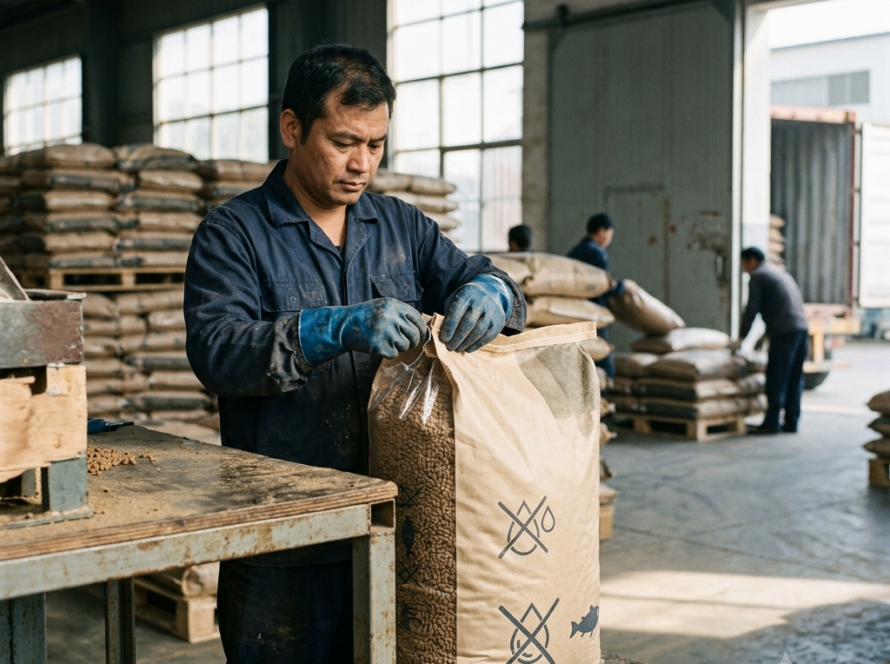
• Seed, Feed & Agricultural Input Sacks: Biodegradable packaging can be used for sacks containing seeds, animal feed, fertilizers, and soil amendments. However, liners, coatings, adhesives, and other components must also be compostable for the entire package to meet compostability requirements.
• Fresh Produce Packaging: Compostable liners and packaging can help keep food scraps and packaging together in the organic waste stream, reducing contamination and making waste handling more efficient.
From Agricultural Waste to Packaging, and Back to the Soil
The story of biodegradable packaging can begin with something as simple as agricultural waste. Rice husks, corn cobs, fruit peels, and other crop residues can serve as raw materials for producing packaging materials. One promising example is polyhydroxyalkanoates (PHA), a family of biopolymers that can be produced when microorganisms ferment agricultural waste. In this way, materials that would otherwise be discarded can be converted into useful packaging and eventually return to the environment.
PHA is particularly interesting because it is made by bacteria themselves. Microbial cells produce and store PHA as an energy reserve, much like animals’ store fat. This biological origin also influences what happens at the end of its life: under suitable conditions, PHA can be broken down by microorganisms in freshwater, seawater, soil, and both home and industrial composting environments (Koller et al., 2025).
But being biodegradable does not mean that PHA will disappear at the same speed everywhere. Environmental conditions play a major role. Moisture and thickness are one of the most important factors. For example, PHB and PHBV films buried in fully saturated soil lost most of their strength within three days and completely degraded within two weeks. Under much drier conditions, at 40% relative humidity, the same films showed little visible change even after six weeks (Kim et al., 2023).
And once the packaging returns to the soil, the story does not necessarily end there. What happens during degradation can also influence the soil ecosystem. At field-relevant application levels, PHA degradation has generally shown limited or neutral effects on crops and soil.
The practical takeaway is simple that closing the loop requires more than making a material biodegradable. The raw material, polymer, packaging format, environmental conditions, and end-of-life pathway all need to work together. When biodegradable packaging is designed with these factors in mind, agricultural waste can move through a meaningful cycle, i.e. from farm residue, to packaging, and ultimately back to the soil.
How It Supports Regenerative Goals
The connection between biodegradable packaging and regenerative agriculture becomes clearer when we look at what happens after the packaging has done its job. Regenerative systems aim to protect soil, support biological activity, cycle resources efficiently, and reduce dependence on external inputs.
Soil health is an important factor. Packaging that is designed to mineralize under the right conditions, rather than breaking down into persistent fragments, has the potential to reduce the long-term plastic burden in agricultural soils. This becomes particularly relevant for materials such as mulch films, nursery items, or other products that are difficult to retrieve after use.
This also aligns with the regenerative principle of reducing dependence on external inputs. Using a farm’s own agricultural residues as feedstock for packaging does not eliminate the need for outside materials, but it can create an opportunity to make better use of resources already present within the farming system.
Circular Economy
The circular version runs in a loop. Crop residues that would otherwise be burned, discarded, or left unused can become the starting point for a new packaging material. These residues can be collected, fermented to produce biopolymers such as PHA, and converted into films, liners, or sacks. After serving their purpose on the farm, appropriately designed materials can then be composted or incorporated into the soil under suitable conditions.
At the material level the is not just hypothetical. PHA can be fermented from agricultural waste, and it does break down in soil and water (Selvam et al. 2025; Koller et al., 2025). What is needed is residue collection at farm scale and processing close enough to make the arithmetic work.
Where TerraPHA Fits
TerraPHA Biotech is World’s first non-GMO biopolymer company, producing PHA using naturally occurring microbial system. It uses precision fermentation processes to make sure the material is produced consistently and can be made on a larger scale.
The company works from diverse renewable feedstocks including waste streams, converting organic and industrial wastes into higher-value material. This flexibility makes the production process more adaptable.
Frequently Asked Questions
Can I just till biodegradable packaging into my field?
Only if it is certified to a soil-biodegradation standard such as EN 17033, which requires 90% conversion to CO₂ within 24 months plus ecotoxicity clearance for plants, earthworms and nitrifying microbes (European Bioplastics, 2018). Material labelled only “compostable” or “oxo-degradable” does not meet that bar.
Does biodegradable material affect my next crop’s nutrition?
At normal field rates, effects have generally been limited or neutral. PHA-based materials are also a potential food source for microbes which will act as a nutrition enhancer for the soil.
References
European Bioplastics. (2018, February 28). New EU standard for biodegradable mulch films in agriculture published. https://www.european-bioplastics.org/new-eu-standard-forbiodegradable-mulch-films-in-agriculture-published/
Govil, T., Saxena, P., Thakur, K., Sharma, Y., Allen, M., Kaur, J., Samanta, D., Sani, R. K., Salem, D. R., & Sharda, A. (2026). Polyhydroxyalkanoate degradation in soils: Mechanisms, controls, biological responses, and knowledge gaps. Frontiers in Microbiology, 17, 1832091. https://doi.org/10.3389/fmicb.2026.1832091
Karwadiya, J., Kerketta, A. R., Pathak, S. K., Srivastava, S., & Darbha, G. K. (2025). Agronomic practices and road proximity drive plastic pollution in agricultural soils: Insights from Bihar, India on weathering, elemental association, and ecological risk. Environmental Pollution, 384, 126975. https://doi.org/10.1016/j.envpol.2025.126975
Kim, J., Gupta, N. S., Bezek, L. B., Linn, J., Bejagam, K. K., Banerjee, S., Dumont, J. H., Nam, S. Y., Kang, H. W., Park, C. H., Pilania, G., Iverson, C. N., Marrone, B. L., & Lee, K.-S. (2023). Biodegradation studies of polyhydroxybutyrate and polyhydroxybutyrate-co-polyhydroxyvalerate films in soil. International Journal of Molecular Sciences, 24(8), 7638. https://doi.org/10.3390/ijms24087638
Koller, M., Heeney, D., & Mukherjee, A. (2025). Biodegradability of polyhydroxyalkanoate (PHA) biopolyesters in nature: A review. Biodegradation, 36(4), 76. https://doi.org/10.1007/s10532-025-10164-y
Newton, P., Civita, N., Frankel-Goldwater, L., Bartel, K., & Johns, C. (2020). What is regenerative agriculture? A review of scholar and practitioner definitions based on processes and outcomes. Frontiers in Sustainable Food Systems, 4, 577723. https://doi.org/10.3389/fsufs.2020.577723
Selvam, T., Rahman, N. M. A., Olivito, F., Ilham, Z., Ahmad, R., & Wan-Mohtar, W. A. Q. I. (2025). Agricultural waste-derived biopolymers for sustainable food packaging: Challenges and future prospects. Polymers, 17(14), 1897. https://doi.org/10.3390/polym17141897
Zeng, J., Wang, X., Wang, J., Dong, H., Zhou, Y., MacLeod, M., Cousins, I. T., Li, Y., Xia, X., Graf, M., Jones, D. L., & Liu, X. (2026). The use, fate and environmental impacts of plastic films in agriculture. Nature Reviews Earth & Environment, 7(8), 528-545. https://doi.org/10.1038/s43017-02600808-9