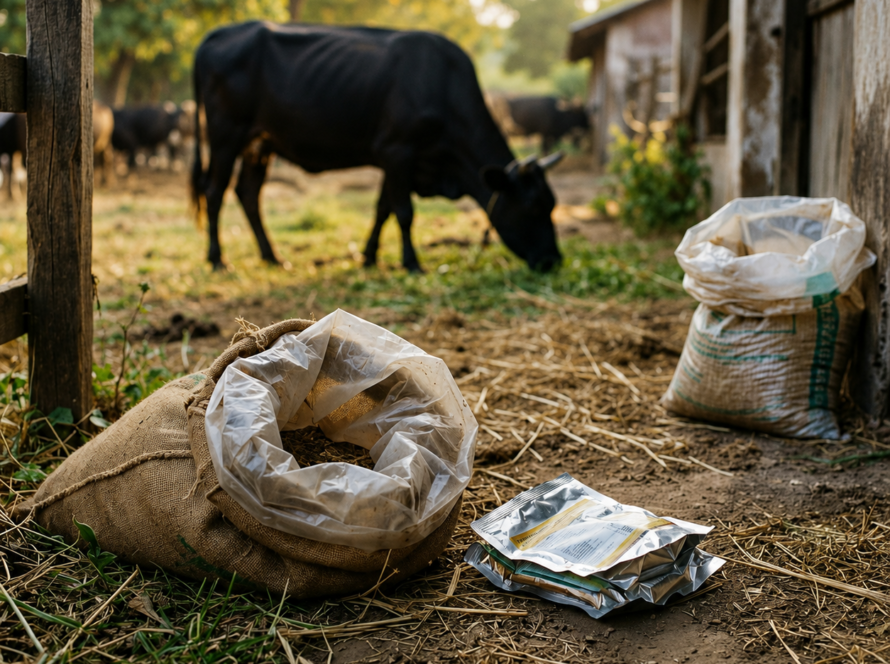
An expiry date represents the manufacturer’s estimate of how long an unopened bag will remain stable when stored under ideal conditions. It does not guarantee the quality of feed once the bag has been opened or exposed to factors such as heat, humidity, air, and improper storage. Feed deterioration is influenced by these environmental conditions rather than the printed date alone, meaning that feed can lose its nutritional quality and freshness well before its stated expiry date.
Feed does not spoil on a calendar. It spoils on oxygen, moisture and heat, and on how much of each the packaging lets through.
Lipid Oxidation Begins First
Aquafeed is formulated around fishmeal and fish oil, both rich in long-chain polyunsaturated fatty acids. The double bonds in these fatty acids are the point at which oxygen attacks. Oxidation proceeds slowly at first and accelerates once free radicals accumulate, which explains why a batch may appear stable for weeks and then deteriorate within days.
Peroxide value offers a measurable indicator. Oils well below 10 mg/kg are regarded as fresh, while values between 20 and 40 mg/kg denote rancidity. Feed retained beyond 90 days at ambient temperature begins to lose oil and vitamins to peroxidation (Solomon et al., 2016).
A Bangladeshi study of three commercial feeds recorded faster quality loss at 25-30 °C than at 5-8 °C and recommended use within two months of manufacture (Hossen et al., 2013). That is a working life of two months against the twelve printed on many bags.
Humidity Compounds the Loss
Mould establishes above approximately 70% relative humidity, a threshold most of coastal India exceeds throughout the monsoon. In a six-month Nigerian storage trial, commercial catfish feeds held in open bags showed colour change, softening, mould growth and a rancid odour from the third month onward, together with seven species of insects (Solomon et al., 2016).
One observation from that trial merits attention. A feed stored in a tied, notionally airtight bag also became damp and musty, because humid air had been enclosed with the pellets. Sealing affords protection only where the enclosed air is dry.
The consequences extend beyond appearance. Mould consumes lysine, arginine, dietary lipid and vitamins (Solomon et al., 2016), and it leaves residues. A global survey of 226 fish feed samples found 98.7% contaminated with at least one of 51 mycotoxins tested, 41.6% carrying aflatoxin B1 and 7.1% exceeding the EU maximum of 10 µg/kg (Gruber-Dorninger et al., 2025).
The Limits Of Conventional Sacks
Woven polypropylene performs well against liquid water. Its resistance to oxygen is negligible, and its resistance to water vapour only partial unless the fabric has been laminated or coated. An uncoated sack in a warm store permits daily exchange of air between the feed and the surrounding environment over a period of months. The contents age according to storage conditions rather than the printed date.
Measurable decline begins well before any visible sign. A 56-day trial on African catfish feed recorded rising TBARS values, increased moisture and declining sensory scores as storage time increased (Uzochukwu et al., 2023).
Where Terrapha Contributes
TerraPHA Biotech addresses the problem on two fronts.
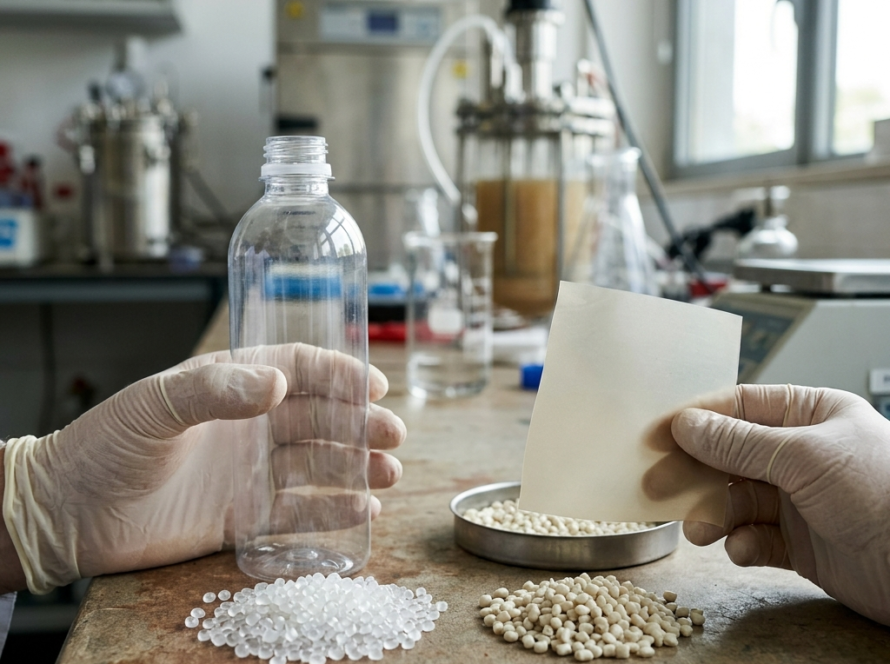
The first concerns materials. Polyhydroxyalkanoates are biopolymers produced by bacterial fermentation. The two grades most studied for food contact, PHB and PHBV, combine strong water vapour resistance with strong oxygen barrier performance, and antioxidant compounds have been incorporated into PHBV films so that the packaging retards oxidation rather than merely resisting it (Moll & Chiralt, 2026). Applied to feed sacks and liners, this brings the packaging inside the preservation system. TerraPHA manufactures non-GMO PHA and develops barrier applications alongside its aquaculture and agriculture ranges.
The second concerns the animal. TerraPRO-AQ50, the company’s PHA-based aquafeed enhancer, supports gut performance, nutrient uptake and growth efficiency in fish and shrimp. Uptake matters more, not less, where every kilogram of feed must recover its cost.
Recommended Storage Practice
- Purchase in smaller lots at shorter intervals rather than committing to a quarter’s stock.
- Store bags clear of the floor and away from external walls, where condensation forms.
- Assess each bag by odour before use and reject any consignment carrying a sharp solvent note, whatever the printed date.
- Record the manufacturing date rather than the expiry, and treat sixty days as the working window in monsoon months.
Frequently asked questions
Does the expiry date on a fish feed bag carry practical meaning?
It indicates that the feed should perform as specified, provided it has been held under the conditions the mill assumed: sealed, cool, dry and undisturbed. The figure represents a best case rather than a guarantee, and under Indian coastal conditions the practical window is much shorter.
How can rancidity be identified before the feed is used?
Odour remains the quickest field assessment. Oxidised fish oil produces a sharp, solvent-like note distinct from the clean marine odour of fresh feed. Dulled colour, softened pellets and a higher proportion of fines provide supporting evidence. For stock destined for a large pond, laboratory determination of peroxide value justifies the cost: below 10 mg/kg indicates freshness, 20 to 40 mg/kg rancidity (Solomon et al., 2016).
Is feed usable once visible mould has been removed?
No. Mycotoxins are chemically and thermally stable and extend well beyond the visible growth, so removing the surface layer eliminates the evidence rather than the hazard. Aflatoxin B1 is hepatotoxic and was detected above the EU maximum in 7.1% of surveyed fish feed samples (Gruber-Dorninger et al., 2025).
Does cold storage resolve the problem?
It slows deterioration substantially. Feeds held at 5–8 °C declined more slowly than equivalent feeds at 25-30 °C, although quality still fell (Hossen et al., 2013). Cold storage is seldom economic at farm scale, which leaves packaging and stock rotation to carry the greater burden.
References
Gruber-Dorninger, C., Müller, A., & Rosen, R. (2025). Multi-mycotoxin contamination of aquaculture feed: A global survey. Toxins, 17(3), 116. https://doi.org/10.3390/toxins17030116
Hossen, M. N., Das, M., Sumi, K. R., & Hasan, M. T. (2013). Effect of storage time on fish feed stored at room temperature and low temperature. Progressive Agriculture, 22(1–2), 115–122. https://doi.org/10.3329/pa.v22i1-2.16473
Moll, E., & Chiralt, A. (2026). Biodegradable and active materials based on PHBV for sustainable food packaging. Sustainable Food Technology, 4(3), 2396–2418. https://doi.org/10.1039/D5FB00936G
Solomon, S. G., Tiamiyu, L. O., Okomoda, V. T., & Adaga, K. (2016). Nutrient profile of commercial aqua-feeds under different storage conditions. International Journal of Aquaculture, 6(12), 1–11. https://www.aquapublisher.com/index.php/ija/article/view/2314
Uzochukwu, I. E., Aba, P. E., Ossai, N. I., Ugwuoke, H. C., Nyeste, K., & Machebe, N. S. (2023). Optimizing feed utilization and reducing deterioration of African catfish feed with sodium propionate supplementation. Aquaculture Reports, 33, 101820. https://doi.org/10.1016/j.aqrep.2023.101820